
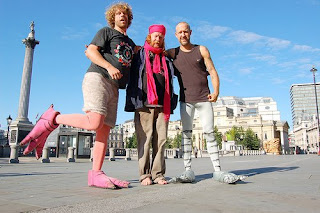
I think the photos (found on Flickr) speak for themselves....
1. a man behaving like a pigeon:
 2. a man, behaving like a pigeon...again:
 3. the man without the costume:
Thursday, 17 July 2008
Flying rats go human !


Wednesday, 16 July 2008
The Luther Burger
This morning, as I was looking at various things on the internet, I stumbled upon this picture on Flickr. Someone had lunch at the Google cafeteria in New York and as a special they were serving Krispy Kreme donoughts with bacon and cheddar....

Beirut or Busk
Following Skiffle and the Busker's Art I found this video of Beirut on another edition of the culture show. (You may have noticed my small but perfectly formed obsession with this band through their featuring heavily in the Interesting Music posts.) Will they beat Mark Kermode and his Dodge brothers....? Watch to find out!
Monday, 14 July 2008
Skiffle and the Busker's Art
Check out the following clip from the BBC's Culture Show. One regular segment of theirs takes major rock/pop stars and puts them on a street for 15 minutes to busk, the proceeds going to charity. A constellation of stars including Moby, Black Francis and Broken Social Scene have all taken part with varying degrees of success. Mark Kermode, more usually known for rubbishing various films happens to be in a skiffle band - The Dodge Brothers. It seems that skiffle is summed up as somewhere between blues and rock'n'roll, using washboards rather than a drum kit (making it extremely portable). Apart from being one of my personal heroes, Dr Kermode (Manchester) happens also to be rather handy with a double bass and has the charisma to pull in the punters (and their cash). Marvellous.
Friday, 11 July 2008
17 Course Crisis
Much has been made recently of the increasing prices of basic commodities such as food and fuel. Amidst the introduction of protectionist export tariffs in some countries and rising inflation and interest rates in others, there is a general atmosphere of a looming crisis around the world. Check out this Rocketboom video for a 3 minute summary:
Crisis indeed. Not so in Hokkaido however where G8 leaders this week rewarded a hard day's chatting with a slap up multiple course banquet comprising the choicest of Japanese delecacies. Churchill apparently was similarly fond of fine food, fine cognac and fine cigars during the strict rationing of the war years. I suppose these sorts of perks are to be expected...
The menu (as reported by the Guardian) read as follows:
- Corn-stuffed caviar
- Smoked salmon and sea urching "pain surprise" style
- Winter lily bulb and summer savoury
- Kelp-flavoured cold kyoto beef shabu-shabu, asparagus dressed with sesame cream
- Diced fatty fles of tuna fish, avocado and jellied soy sauce and Japanese herb "shiso"
- Boiled clam, tomato, Japanese herb "shiso" in jellied clear soup of clam
- Water shield and pickled conger dressed with vinegar soy sauce
- Boiled prawn with jellied tosazu-vinegar
- Grilled eel rolled around burdock strip
- Sweet potato
- Fried and seasoned Goby with soy sauce and sugar
- Hairy Crab "Kegani" bisque soup
- Salt-grilled bighand thornyhead with vinegary water pepper sauce
- Milk fed lamb from "shiranuka" flavoured with aromatic herbs and mustard
- Roasted lamb and cepes and black truffle with emulsion sauce of lamb's stock and pine seed oil
- Special cheese selection, lavender honey and caramelised nuts
- G8 fantasy dessert
Well it's good to know that they're taking it all so seriously. Presumably Mr Brown made the left-overs into a convenient flan rather than throwing away the 30% that we British are prone to waste. Watch for spin-doctors' heads rolling out of Whitehall.
Also check out the FT report and the Guardian report.
Thursday, 26 June 2008
London: a trip to the metropolis
 So here I am. Trafalgar square. Monument to imperialism, war and the triumph of Graeco-Roman educated northern European stiff upper lip over a small beligerent Frenchman. Le Fox of course, being one of our kir-swilling crepe-eating brethren from the-other-side-of-le-manche isn't with here with me, taking Nelson's column as a direct insult to the French red, white and blue. Ok, i made that up, but being avian-averse, she wouldn't have a particularly good time anyway.
I've just walked here from Buckingham Palace along Whitehall, the seat of British power. The palace's environs are full of well-to-do houses, old world clubs and stretches of green, all ceremonially guarded by soldier in funny hats on funny horses. From these treelined streets, Whitehall seemed most clinical. Security guards and tourists everywhere-imposing white buldings from which one fifth of humanity was once governed. It seemed rather apt that the side entrance to Buckingham palace (through which the scones and crumpets pass, never to return) was relatively deserted with a traffic cone blocking the part of the opening not covered by the automatic barrier.
In comparison, Downing street seemed like a fortified bunker with successive lines of huge railings complicated entry systems and stern looking flak-jacketed police. Is the Prime Minister so unpopular? How sad the Queen must feel, no longer inspiring enough hatred in her subjects to warrant greater protection.
So here I am. Trafalgar square. Monument to imperialism, war and the triumph of Graeco-Roman educated northern European stiff upper lip over a small beligerent Frenchman. Le Fox of course, being one of our kir-swilling crepe-eating brethren from the-other-side-of-le-manche isn't with here with me, taking Nelson's column as a direct insult to the French red, white and blue. Ok, i made that up, but being avian-averse, she wouldn't have a particularly good time anyway.
I've just walked here from Buckingham Palace along Whitehall, the seat of British power. The palace's environs are full of well-to-do houses, old world clubs and stretches of green, all ceremonially guarded by soldier in funny hats on funny horses. From these treelined streets, Whitehall seemed most clinical. Security guards and tourists everywhere-imposing white buldings from which one fifth of humanity was once governed. It seemed rather apt that the side entrance to Buckingham palace (through which the scones and crumpets pass, never to return) was relatively deserted with a traffic cone blocking the part of the opening not covered by the automatic barrier.
In comparison, Downing street seemed like a fortified bunker with successive lines of huge railings complicated entry systems and stern looking flak-jacketed police. Is the Prime Minister so unpopular? How sad the Queen must feel, no longer inspiring enough hatred in her subjects to warrant greater protection.
Monday, 23 June 2008
BM est. 1759
 Finally, since I am in London after all, I thought it only right that I visit the British Museum. The first time i walked into this building, I didn't quite know what to expect. The huge classical colonade gives way at the entrance to a dark foyer flanked by the giftshop and a couple of galleries. I remember thinking that it would be full of very stuffy old men looking at very stuffy old exhibitions which would be nothing more than the trophy cabinets of dead merchant soldiers.
  Nothing could be further from the truth. Walking through, the dark recess suddenly opens into a huge marble space. In the centre is the cylindrical reading room, famous perhaps more for Marx choosing it as his study while writing the communist manifesto than for its books. Now it is simply an architectural curiosity, the constant stream of tourists making constructive thought rather difficult. I suppose that originally, this part was open to the elemts before it was roofed over in the 90s with a perspective warping glass triangulation.
This time my attention was drawn by a 1st century AD statue of a cheeky chappy on horseback, featured to the right. The thing that caught me more than anything else was that he was naked in all the 'important' areas, and yet sports a pair of sandals and a lovely oversized handkercheif. Either that or he just hasn't quite mastered the art of wearing a toga.
Thursday, 19 June 2008
Picadilly, Peekahdeelee, Pick-a-Deli...? a culinary exchange

- Pimm's with lemonade - because it's got cucumber in it, which I think is eccentric
- sausage and mash patatoes with ale - because it's easy and filling pub food
- peas with mint - because other French people hate it
- crumpets - who would have thought that bread could have such a consistency
- Scones with clotted cream and strawberry jam - because the Queen's beagles have it for breakfast
- pheasant - especially if it's home killed in fox hunting costume and AGA cooked
- christmas pudding and mince pies
- jacket patatoes with beans and cheese - because that's the only decent food from my work cafeteria
Wednesday, 18 June 2008
Sunday, 15 June 2008
Acquiring target...
 Stalking friends through facebook (hurrah!) I stumbled upon the following bit of Tai Chi for the tech-generation:
my morning ritual Date: 2004-05-10, 9:56AM EDT I have a morning ritual that I need to share. I call it "the terminator". First I crouch down in the shower in the classic "naked terminator traveling through time" pose. With my eyes closed I crouch there for a minute, visualizing either Arnold or the guy from the second movie (not the chick in the third one because that one sucked) and I start to hum the terminator theme. Then I slowly rise to a standing position and open my eyes. It helps me to proceed through my day as an emotionless, cyborg badass. The only problem is if the shower curtain sticks to my terminator leg. It ruins the fantasy. I think maybe I read too many comic books when I was a kid...
Having returned to my chair from the floor (which I should probably hoover one of these days) I remembered something I'd read recently about research happening at the University of Washington. Forget massive virtual reality headsets from the nineties, forget cinema specs from the noughties, think Terminator style text superimposed on the world - the contact lens display is here.
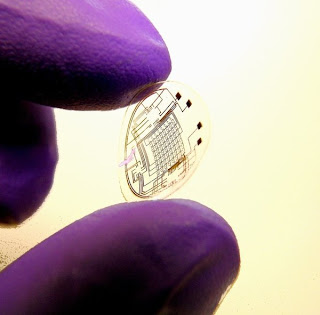
Ok, it's not totally here yet, at the moment it's an array of minute LEDs in a contact lens, but the possibilities are intriguing. These circuts are so small that manufacturing them by hand is impossible. Instead, somehow the team harnesses capillary action to have the components assemble themselves. This to me is a marvel in itself - that a collection of parts can somehow be designed in such a way that it is their very nature to combine in an ordered way is completely mindblowing. This is apparently old hat. The main issue was to make the lens itself biologically inert. To do this, the circuit, which is itself only nanometers thick, is sandwiched between a couple of layers of an inert polymer. Nevertheless, the lens has only been tested on rabbits so far to check for adverse effects.
No doubt this will soon be snapped up by some corporation or other for further investment. In a few years we'll all be able to play at being Arnie...
Saturday, 14 June 2008
The Man With No Name

I just read that most American presidents cite their favourite films as westerns. I really like westerns. I know that most people don't. For me, it's probably a cultural thing- I grew up on a farm, my dad is kind of a cowboy, he liked westerns, so I learned to as well.
Traditional westerns (al la Serge Leone) are really really slow. It's all about the anticipation. Most people hate this pace- they get bored. This is something that's really copied by Tarentino in Kill Bill which I think is fantastic. Watching the final confrontation in The Good, the Bad and the Ugly or many of the scenes in Kill Bill, I just savor the timing. I'm practically bouncing in my seat while other people are looking at their watches. Basically its the complete opposite of say the Transformers or Die Hard. I think that you have to learn to watch these films- just like someone might learn to appreciate opera- to truly get the most out of them.
And don't even get me started on the music... ah, Ennio Morricone! If only you could do the soundtrack to my life...
Cowboys and the wild west are one of the most popolar and romantic themes in American life. They're frougth with strife in reference to the reality- the politics of American expansion, the (un)reality of the American Dream/Manifest Destiny. I know both- but if I'm asked I'll say I wish I lived during this time period. People want to control their own destiny in their own way, they want to think that they're moral and good, and have the power to act on this. They want to be clever and powerful but independent and self sufficient. Hence the popularity with presidents, I think.
So let me know when you're ready for me to bring over my dvd collection, and we'll begin the education...
World Wide Knit in Public Day
For me, not as much fun as cycling naked. Unless I knit naked! Hmm... http://www.wwkipday.com/
Friday, 13 June 2008
More interesting music
You are listening to:
- Cars -Gary Numan
- Get over - dream
- Flower of Northumberland - John Renbourn group
- The Sea - Morcheeba
- Mount Wroclai - Beirut
- Let no man steal your thyme - Pentangle
- Wonderful life - Black
- Is she weird? - Pixies
- Silence is golden - The Tremeloes
Thursday, 12 June 2008
"Cet affreux cauchemar est termine..."
 Cauchemar is the French word for nightmare. It is derived from cauquemaire used in the 15th century. It is composed of the words caucher and mare.
Caucher is derived from cauchier which means "to press". Cauchier is probably a mix of the ancient French word chauchier ("to press" or "to tread upon") and the latin word calcare ("to sprain one's ankel" or "to heel")
Mare comes from the Picard word mare, borrowed from the Dutch word mare (which means "ghost").
Cauchemar is the French word for nightmare. It is derived from cauquemaire used in the 15th century. It is composed of the words caucher and mare.
Caucher is derived from cauchier which means "to press". Cauchier is probably a mix of the ancient French word chauchier ("to press" or "to tread upon") and the latin word calcare ("to sprain one's ankel" or "to heel")
Mare comes from the Picard word mare, borrowed from the Dutch word mare (which means "ghost").
Wednesday, 11 June 2008
Ghost in the Shell
 Over the weekend, Le Fox and I, beckonned on by the Manga exhibition at Urbis (which led to the Guerilla Gardening post) decided to watch the first two Ghost in the Shell films. They're Japanese animated films with the usual futuristic distopia filled with crazed cyborgs and corrupt corporations. Widely cited as major inspiration for The Matrix, it tells the story of two crime fighting cyborgs in a bionic society infused with chips and circuits as they try to track down the mysterious Puppet Master who constantly hacks into things. Surfing the internet is plugging your brain directly into the system - vulgar interfaces are rarely used. I must admit to cringing from time to time however at the pseudo-philosophical pronouncements about being and self. There were certainly times when dialogue gave way to a long and drawn out soliloquy tossed from character to character...
Puppet Master: It can also be argued that DNA is nothing more than a program designed to preserve itself. Life has become more complex in the overwhelming sea of information. And life, when organized into species, relies upon genes to be its memory system. So man is an individual only because of his intentional memory. But memory cannot be defined, but it defines mankind. he advent of computers and the subsequent accumulation of uncalculable data has given rise to a new system of memory and thought, parallel to your own. Humanity has underestimated the consequences of computerization.
Nakamura: Nonsense! This is no proof at all that you're a living, thinking life form.
Puppet Master: And can you offer me proof of your existence? How can you? When neither modern science nor philosophy can explain what life is.
All of this said, I did actually quite enjoy it. One of the marvels of this film is that it is based on a 1989 Manga: it really is incredibly forward thinking in terms of its predictions for technology in society. Alas, the copy of the first film we had was dubbed into a collection of terrible American accents which seemed to jar significantly with the Japanese aesthetic (which was magnificient). Having slated dubbing, Archie pointed out that perhaps I was suffering from what his hero Edward Said would have called Orientophilia. Indeed, perhaps the dialogue in Japanese was just as stilted, and intentionally so - the eyes of all the cyborgs in the film are intentionally unblinking. 
Our copy of the second film, Ghost in the Shell 2: Innocence was nicely subtitled which certainly added to the experience. This time, the cyborg police investigate a series of murders perpetrated by a new line of sexually enabled robots.
Made in 2004, the visual effects were an age ahead of those in the first Ghost in the Shell. Clearly conscious of its legacy in The Matrix, this film seemed much more overtly philosophical quoting Confuscious every other sentence with some scenes made up entirely of one character sending forth a line from Paradise Lost, the other promptly riposting with Psalm 113. Again, toward the end dialogue gave way to a game of 'catch the bludgeoning moral soliloquy'. By far the most interesting parts of the film were the aesthetic mastery - there is an astounding parade at one point which took my breath away, the music - which was specially composed and based on Hungarian chant, and the creators' vision for the integration of technology into every day life.
Both of these films are definitely worth watching - perhaps you are less cynical than me and can rise above the cringeworthy moments. Here are a couple of particularly visually stunning scenes, one from the first and one from the second (I know, youtube hardly does them justice):
Sunday, 8 June 2008
The Space Elevator
 One of my friends many years ago asked me if I'd heard of Konstantin Tsiolkovsky. I hadn't. Being an ardent devotee of science fiction, she had not only heard of him but was a great admirer of his forward thinking work. Here's a brief run-down:
- Born 1857 in the Russian Empire, died 1935.
- Theoretical engineer/physicist/futurist.
- Substantially self taught, as a result of childhood deafness.
- Having seen the Eiffel tower (which was the tallest building in the world at the time) dreamt up the idea of a Space Elevator.
- Wrote the first academic treatise on rocketry.
- Postulated that in order to acheive orbital velocity, a multistage rocket fuelled by liquid hydrogen and oxygen would be needed.
- Just generally a man well before his time.

For those that don't know (and want to), the space elevator is a theoretical device for transporting objects into orbit cheaply without the need for rockets etc. The basic setup is a huge cable stretching from the earth into space. As long as the centre of mass of the cord is at the right distance from the earth, it will stay in geostationary orbit and so remain taught on its own. Check out the picture (taken from here).
The great advantage of something like this is that once buit, it would eliminate the need for rockets when launching satellites into orbit thereby cutting down significantly on costs. The main barrier to the practicality of such a scheme as far as I am aware is one of materials. In order for this to be practical in any way, an incredibly strong and light material would be needed for the tether.
Fear not! Over the past couple of decades, interest in so called carbon nanotubes has exploded. These are allotropes of carbon (like graphite, diamond, buckyballs etc) which have a tublike structure posessing great tensile strength while at the same time being incredibly light.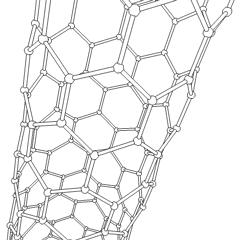 Unfortunately, as with most pipe-dreams, these are as yet impractical on a large scale, being quite tricky to manufacture even in small quantities... Oh well, we can dream (like Tsiolkovsky).
Some links:
Saturday, 31 May 2008
Critical Mass and the Automobile
 illustration by Jim Swanson
I was recently reading Chris Carlsson's book "Critical Mass: Bicycling's Defiant celebration" which is a compilation of various articles from worldwide newspapers and zines. According to one of the articles, there was a sort of proto-Critical Mass (see SocioMath's article here) in San Francisco in 1896. At the time, cyclists, or wheelmen as they seem to have called themselves, were annoyed at the lack of good roads and the ubiquity of raised tramlines in the centre of roads. They campaigned in particular for roads to be built properly so that cycling (which at the time was seen as 'the modern transport') would become easier for commuters. Their lobbying actually had some effect and the roads were modernised. Ironically of course, this paved the way (ho ho) for mass produced automobiles which eventually relegated cyclists again to second citizens of the road.
Perhaps Critical Mass now should seek to provide true cycling highways for people who would like to travel slightly farther afield (in particular suburban commuters) by building major cycle paths through cities.
I read more than a year ago about the so called National cycle network which I assumed would be a network of cycleways throughout the country, finally making it practical and easy to travel long distances by bike. My first impulse was to cycle from here across the Penines to York and lo! there is indeed a route - namely the Transpenine Trail. Unfortunately however, this route is not in any way designed for speed - the website mentions parts of the track which are 'off road'.
This morning I thought it might be a good idea to check out a slightly better route along part of the Fallowfield loop. I cycled west from Fallowfield along the disused railway line and then up to Salford Quays for a bit of a break before heading back to the city centre. The cycleway for as long as it lasts, is great - with the exception of the sporadic barriers. If only there were such a route say from south Manchester into the city centre itself:- imagine the number of people who would use this to commute.
 chain and rider lubrication in Salford
Wednesday, 28 May 2008
Interesting Music
You are listening to:
- Elephant Gun - Beirut
- Stay - Maurice Williams and the Zodiacs
- She's not there - The Zombies
- You showed me - The Turtles
- I'm happy just to dance with you - The Beatles
- Dimples - John Lee Hooker
- Oliver's Army - Elvis Costello and the Attractions
- Echo Beach - Martha and the Muffins
- Belle qui tiens ma vie - John Renbourn group
Monday, 26 May 2008
Gunther von Hagens (Anatomist)
 Dr Gunter von Hagens in front of his work (from www.bodyworlds.com )
Today, Le Fox and I were invited, through mere serendipitous fortune, to a question and answer session with the mysteriously eccentric Gunther von Hagens. For those not in the know, the Body Worlds exhibitions have been confronting taboos throughout the world with its sensationalist if not puritanical insistence on public knowledge of anatomical detail since its Japanese inception in 1995. Gunther von Hagens himself is the leading proponent of the concept of a modern renaissance man. He claims:
Dr Gunter von Hagens in front of his work (from www.bodyworlds.com )
Today, Le Fox and I were invited, through mere serendipitous fortune, to a question and answer session with the mysteriously eccentric Gunther von Hagens. For those not in the know, the Body Worlds exhibitions have been confronting taboos throughout the world with its sensationalist if not puritanical insistence on public knowledge of anatomical detail since its Japanese inception in 1995. Gunther von Hagens himself is the leading proponent of the concept of a modern renaissance man. He claims:
“The presentation of the pure physical reminds visitors to BODY WORLDS of the intangible and the unfathomable. The plastinated post-mortal body illuminates the soul by its very absence. Plastination transforms the body, an object of individual mourning, into an object of reverence, learning, enlightenment, and appreciation. "I hope for BODY WORLDS to be a place of enlightenment and contemplation, even of philosophical and religious self-recognition, and open to interpretation regardless of the background and philosophy of life of the viewer."On Saturday night, I found myself in the extraordinary position of inquisitor in a closed session with the progenitor of Body Worlds 4 himself. My question, rather flacidly put, was: "In your exhibition, you quote Descartes' Medations on First Philosophy and allude to Vesalius' groundbreaking discoveries in the field of anatomy, in particular his direct opposition to Galen. Descartes work marked the transition from a scholastic age of philosophy to an age of rationalist foundationalism (and Cartesian dualism), while Vesalius revealed to us fundamental new discoveries relating to that most basic of questions: of what stuff are we made? Where in the history of knowledge do you place yourself, and how do you judge your legacy to future generations?" Of course, this paraphrased piece of nonsense is a dressed up version of the question I would have asked had my inexperience not entirely paralysed me with a mix of awe and stereotypical British politeness. As it was, I asked a messy question along the same lines but put with much less force and sadly lacking in eloquence. He answered rather obliquely, insisting that personal vanity did not enter into Body Worlds.

A plastinated man
Let me put my opinion on Body Worlds in some context. Initially, spurred on by the widespread pubic fervour, I was convinced by a wily Le Fox that it would be an experience not to be missed to see the public airing of Dr von Hagen's most controversial exhibition to date. With considerable misgivings and almost insurmountable cynicism, we made our way to the MoSI, as it has been rebranded, to see what there was to see. Once I'd entered the first of the four or five crowded halls, I was struck by an intense feeling of awe, my gaze settling on installations of carefully arranged muscle and connective tissue. There were certainly cringeworthy moments, not least reading Goethe quoted next to 'Gunter von Hagens (Anatomist)'. (Incidentally, when i put this to him, Dr von Hagens himself seemed noticably to cringe, placing the blame squarely on the shoulders of his wife's design of the exhibition.)
I must admit however that the my general experience was overwhelmingly one of wellbeing and a greater awareness of the viscera of which we are, as human beings, composed. Interspersed between the deliberately provocative poses were some truly fascinating invitations to medical science and disease. Comparative displays of normal lungs and livers with those of smokers and drinkers were a graphic health warning and seemed to fulfill one of Dr von Hagen's stated aims of promoting greater body awareness among the general pubic.
The rather disappointing truth is that in order to maximise visitor numbers, Body Worlds must rely on sensationalism for its marketing which paints it as anything but serious science. The meeting showed more than anything that Gunther von Hagens is primarily an academic with a passion for anatomy and its public understanding. The success of Body Worlds has had the unfortunate consequence of his message being subsumed by the publicity machine that surrounds him and the rabid commercialism that inevitably followed.
Check out these links for more:
Saturday, 24 May 2008
Naked as the day you died
 So... Manchester Museum has covered up it's mummies. Director Nick Merriman has said that due to visitor complaints, they are now to be covered with cotton shrouds. The archaeologists and staff in the egyptology and archaeology departments (and many others) are very upset at this.
At first I was confused. This was the first headline I saw about the story:
My initial thought was something to the effect of 'stupid puritans even hate dead naked people.' However, reading between the lines of this rather biased first article, I suddenly realized I'd stumbled upon an issue I was very familiar with- the repatiration of human remains.
Working at the archaeological site of a Native American village for many years, I was well versed in NAGPRA (Native American Graves Repatriation Act) and I admit that when I first came to England, and saw human remains on display- probably these very mummies in fact, because I first lived in Manchester- I was very shocked. Not because they were naked, but I had been schooled in the idea that putting human remains on view was entirely disrespectful and innapropriate.
I think that this article from the Guardian gives a more balanced view.
Native American bodies- skeletons, etc- used to be the centre of many American museum exhibitions, and I often received phone calls from elderly museum goers who recalled viewing them on display at our sister museum downtown. They wanted to know where the 'dead Indians' had gone and how dissapointed they were to not be able to show their grandchildren. I would swallow and politely inform them that this was not appropriate any more and that the bodies had most likely been returned to their descendants and reburied.
So... what do I think about this? Just because something has always been done doesn't mean it's right. If there are some descendents of the mummies- indigenous people of Egypt, etc- who protest them being on show then I say they should be taken off display and returned. This freaks a lot of archaeologists out because they say that they'll lose their collections and chance for scientific study. Well even though I love archaeology, I can whole heartedly admit that it is a product of colonialism and was mainly insitited to reinforce its hegemony through it's 'discoveries'- to make indigenous peoples an other, regulat them to the past, and take away the rights of their descendents. Well, that's its worst side. At it's best, it teaches us important lessons about the past and connects us to it.
I've pretty much gotten it into my head that England/Europe is ahead of America in many ways (fashion, gay marriage, health care, etc) but in this case I'm really surprised that so many people are being so old school and raging against the machine. Mummise rank right up there with dinosaurs, in attracting families and others to gawk at museum collections. I'd think that museums would want to try to find a more meaningful way to attract and engage their audiences. After working in museums for over seven years, I don't think I'm being too niave about this.
Subscribe to:
Posts (Atom)
