Showing posts with label music. Show all posts

Monday, 15 September 2008

The Power Ballad Conspiracy

Remember the 80s? Don't answer that. Those ten years made up the best possible tribute to that most hallowed of musical forms - the Power Ballad. I was listening to Bonnie Tyler's Total eclipse of the heart today and thought it sounded rather like Meatloaf. Indeed, it sounded like a lot of songs I remember from the 80s. I discovered that in fact there was a much more tangible link between all of these; the man, the legend - Jim Steinman. He wrote and produced all of these songs and many more including:

In fact, he wrote the whole of Bat out of Hell (I&II) and a significant proportion of 80s chart music. Amazing eh?

Sunday, 14 September 2008

A little net music

This time I decided to go classical on your asses.

You are listening to:
  1. Vi ricorda ò boschi ombrosi from the (first surviving) opera Orfeo by Monteverdi. Performed by the Savall ensemble.
  2. Una Furtiva Lagrima from Donizetti's L'Elisir d'Amore. Pavarotti.
  3. Now is the month of maying by Thomas Morely. Performed by the King's Singers as part of the Madrigal History Tour (hoho!)
  4. 2nd movement (Allegretto) from Beethoven VII. Performed by Berlin Philharmonic under Karajan
  5. Vltava (Moldau) from Ma Vlast by Smetena. Performed by Czech Philharmonic under Kubelik.
  6. Denn alles fleisch es ist wie gras from Brahms' Deutches Requiem. I don't know who's performing it.

Friday, 12 September 2008

Belle qui tiens ma vie

I thought I'd write a quick little ditty about a bit of music with which I have been strangely obsessed ever since we sang it in the Burlington Choir a couple of months ago. It's a piece by Thoinot Arbeau (1519-1595), real name Jehan Tabourot originally written as an instrumental dance. Apparently Arbeau was a master of dances and wrote the definitintive book on Renaissance dance, the Orchésographie from which much of modern knowledge about the period is derived. The pavane Belle qui tiens ma vie is I think one of the very few pieces in the Orchésographie with all four parts filled in by Arbeau himself, the others having only the top line. Here's a facsimile of the relevant pages and here's a modern version.

Perhaps because all of the original parts are included, this seems to have sparked off a great number of people with their own versions. The one which strikes me as most like an actual dance is that of The Broadside Bandand excerpt of which I couldn't find online, but which is being played in the background of this YouTube video. What follows are a load of versions which get progressively... well I'll let you decide.

Check out:

Thursday, 4 September 2008

Undercover Busker

One of my friends sent me this great article from the Washington Post. It turns out, Joshua Bell, virtuoso violinist by day, asleep by night, decided to busk one morning in a DC rush-hour to see what would happen. Check it out.

And here's the article from which this post came. Oh, and here's the article in Terrence Tao's blog which pointed Steve at the WP article. Oh and here's another similar experiment with abstract art instead of a violin. Well I guess I might as well embed the video (complete with plinky plonky piano music so that you know it's deep). See if you can spot the subterreanian moral gravitas.

Monday, 1 September 2008

Zoe Keating

Just heard Zoe Keating on the always excellent Radio Lab.

It's like a one man band, but with a cello and a computer. She plays a couple nice tunes in this piece.

Of course, radiolab isn't usually about funky cellists. It's usually about blowing you mind.

Sunday, 24 August 2008

Philonous's MashUp Collection

Inspired by Danzig vs. Shakira, I've hand picked some rather good (if I do say so myself) mashups and put them together in this easily digestible format...

You are watching
  1. Prodigy vs. Enya
  2. Snoop Dog vs. Led Zeppelin
  3. Pink vs. Billy Idol
  4. Michael Jackson vs. Metallica

Monday, 18 August 2008

Danzig vs. Shakira

Friday, 15 August 2008

Math Capella

I was first sent this back in 2005 at which point I didn't really know what it was all about. Now that I'm finally in the position where I actually get the jokes, I figure I can share it with you without loss of face. Behold the Klein Four: an A Capella group composed of mathematics students at Northwestern University near Chicago. They're clearly differential geometers/mathematical physicists. It's what all the cool kids do.

This simply cannot be beaten for sheer density of maths puns. Buy T-shirts here.

Thursday, 31 July 2008

God Bless America

'Cause it ain't the only place on Earth, but it's the only place that I prefer.

Wednesday, 23 July 2008

Roots (disambiguation)

In Euclidean Space:

Let V be a finite-dimensional Euclidean space, with the standard Euclidean inner product denoted by . A root system in V is a finite set Φ of non-zero vectors (called roots) that satisfy the following properties:

  1. The roots span V.
  2. The only scalar multiples of a root α ∈ Φ that belong to Φ are α itself and −α.
  3. For every root α ∈ Φ, the set Φ is closed under reflection through the hyperplane perpendicular to α. That is, for any two roots α and β, the set Φ contains the reflection of β in the plane perpendicular to α.
  4. (Integrality condition) If α and β are roots in Φ, then the projection of β onto the line through α is a half-integral multiple of α.
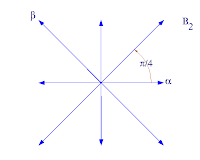
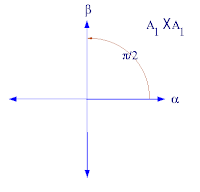
In view of property 3, the integrality condition is equivalent to stating that β and its reflection σα(β) differ by an integer multiple of α. The rank of a root system is the dimension of the Euclidean space V in which it resides. Here are examples of rank 2 systems.
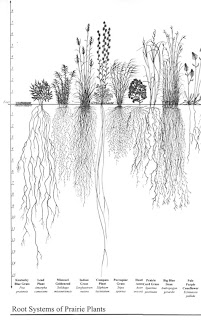
In the Plant Kingdom: In vascular plants, the root is the organ of a plant body that typically lies below the surface of the soil. But, this is not always the case, since a root can also be aerial (that is, growing above the ground) or aerating (that is, growing up above the ground or especially above water). On the other hand, a stem normally occurring below ground is not exceptional either (see rhizome). So, it is better to define root as a part of a plant body that bears no leaves, and therefore also lacks nodes. There are also important internal structural differences between stems and roots. The two major functions of roots are 1.) absorption of water and inorganic nutrients and 2.) anchoring the plant body to the ground. Roots also function in cytokinin synthesis, which supplies some of the shoot's needs. They often function in storage of food. The roots of most vascular plant species enter into symbiosis with certain fungi to form mycorrhizas, and a large range of other organisms including bacteria also closely associate with roots.
On TV:

Roots is a 1977 American television miniseries based on Alex Haley's work Roots: The Saga of an American Family, his critically acclaimed but factually disputed genealogical novel.

Roots was made into a hugely popular television miniseries that aired over eight consecutive nights in January 1977. Many people partially attribute the success of the miniseries to the original score by Quincy Jones. ABC network television executives chose to "dump" the series into a string of airings rather than space out the broadcasts, because they were uncertain how the public would respond to the controversial, racially-charged themes of the show. However, the series garnered enormous ratings and became an overnight sensation. Approximately 130 million Americans tuned in at some time during the eight broadcasts. The concluding episode was rated as the third most watched telecast of all time by the Nielsen corporation. The cast of the miniseries included LeVar Burton as Kunta Kinte, Leslie Uggams as Kizzy and Ben Vereen as Chicken George. A 14-hour sequel, Roots: The Next Generations, aired in 1979, featuring the leading African-American actors of the day. In 1988, a two-hour made-for-TV movie, Roots: The Gift, aired. Based on characters from the book, it starred LeVar Burton as Kunta Kinte, Avery Brooks as Cletus Moyer and Kate Mulgrew as Hattie, the female leader of a group of slave catchers.

In the Charts:

Roots is the sixth studio album by Brazilian thrash metal band Sepultura, released in 1996 through Roadrunner Records. It was the band's last album to feature Max Cavalera. The majority of the themes presented on Roots are centered on Brazilian politics and culture.

The inspiration for Sepultura's new musical directon was two-fold. One was the desire to further experiment with the music of Brazil, especially the percussive type played by Salvador, Bahia samba reggae group Olodum. A slight influence of Northeastern Brazil's native music is also present in the guitar riffs, especially baião and capoeira music. Another innovation Roots brought was the inspiration taken from the (then) cutting-edge nu metal sound of the Deftones and KoЯn - especially the latter's debut, with it's heavily down-tuned guitars.
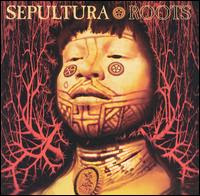
Roots was released in February 1996 and received with unprecedented enthusiasm. Even the popular press, that usually doesn't pay a lot of attention to metal records, halted the presses to appreciate the unusual rhythms mixture of Sepultura. American newspapers like The New Times, the Daily News[disambiguation needed] and the Los Angeles Times reserved some space for the Brazilian band: "The mixture of the dense metal of Sepultura and the Brazilian music has a intoxicating effect", wrote a Los Angeles Times' reviewer. The Daily News went even further: "Sepultura reinvented the wheel. By mixing metal with native instruments, the band resuscitates the tired genre, reminding of Led Zeppelin times. But while Zeppelin mixed English metal with African beats, it's still more moving to hear a band that uses elements of its own country. By extracting the sounds of the past, Sepultura determines the future direction of metal".

Acknowledgements: This post would not have been possible without the untiring effort of all of those kind folk at Wikipedia who are up at all hours of the day and night writing entries. I'd also like to thank they keys Ctrl, C and V

Wednesday, 16 July 2008

Beirut or Busk

Following Skiffle and the Busker's Art I found this video of Beirut on another edition of the culture show. (You may have noticed my small but perfectly formed obsession with this band through their featuring heavily in the Interesting Music posts.) Will they beat Mark Kermode and his Dodge brothers....? Watch to find out!

Monday, 14 July 2008

Skiffle and the Busker's Art

Check out the following clip from the BBC's Culture Show. One regular segment of theirs takes major rock/pop stars and puts them on a street for 15 minutes to busk, the proceeds going to charity. A constellation of stars including Moby, Black Francis and Broken Social Scene have all taken part with varying degrees of success. Mark Kermode, more usually known for rubbishing various films happens to be in a skiffle band - The Dodge Brothers. It seems that skiffle is summed up as somewhere between blues and rock'n'roll, using washboards rather than a drum kit (making it extremely portable). Apart from being one of my personal heroes, Dr Kermode (Manchester) happens also to be rather handy with a double bass and has the charisma to pull in the punters (and their cash). Marvellous.

Wednesday, 18 June 2008

Love song

The other day The Lodger and I were watching Flight of the Conchords:

Sunday, 20 April 2008

Writer's block and favourite poem

I thought it would be nice to post my favourite poem. It was composed by the German dada artist Kurt Schwitters. It is a love poem that doesn't make sense (a translation is posted after the original):

o du, geliebte meiner siebenundzwanzig sinne, ich liebe dir! - du deiner dich dir, ich dir, du mir. - wir? das gehört (beiläufig) nicht hierher. wer bist du, ungezähltes frauenzimmer? du bist - bist du? - die leute sagen, du wärest - laß sie sagen, sie wissen nicht, wie der kirchturm steht. du trägst den hut auf deinen füßen und wanderst auf die hände, auf den händen wanderst du. hallo, deine roten kleider, in weiße falten zersägt. rot liebe ich anna blume, rot liebe ich dir! - du deiner dich dir, ich dir, du mir. - wir? das gehördt (beiläufig) in die kalte glut. rote blume, rote anna blume, wie sagen die leute? preisfrage: 1. anna blume hat ein vogel. 2. anna blume ist rot. 3. welche farbe hat der vogel? blau ist die farbe deines gelben haares. rot ist das girren deines grünen vogels. du schlichtes mädchen im alltagskleid, du liebes grünes tier, ich liebe dir! - du deiner dich dir, ich dir, du mir - wir? das gehört (beiläufig) in die glutenkiste. anna blume! anna, a-n-n-a, ich träufle deinen namen. dein name tropft wie weiches rindertalg. weißt du es, anna, weißt du es schon? man kann dich auch von hinten lesen, und du, du herrlichste von allen, du bist von hinten wie von vorne: "a-n-n-a." rindertalg träufelt streicheln über meinen rücken. anna blume, du tropfes tier, ich liebe dir! (Kurt Schwitters, An Anna Blume)

This poem has also inspired the German hip-hop band Freundeskreis:

Translation:

You, oh you, beloved of my twenty-seven senses, I love ya! - You thine thou yours, I you, you me. - Us? This (incidentally) does not belong here. Who are you, countless woman? You are - are you? - People say you are - let them say it, they don't know where the steeple is. You wear a hat on your feet and stand on your hands, on your hands you walk. Hello, your red clothes, sawed into white pleats. Red I love, Anna Blume, red I love ya! - You thine thou yours, I you, you me. - Us? That (incidentally) belongs in the cold embers. Red flower, red Anna Blume, what are people saying? Prize question: 1. Anna Blume has a bird. 2.Anna Blume is red. 3.What color is the bird? Blue is the color of your yellow hair. Red is the cooing of your green bird. You plain girl in an everyday dress, you dear green animal, I love ya! - You thine thou yours, I you, you me - us? That (incidentally) belongs in the ember box. Anna Blume! Anna, a-n-n-a, I am dripping your name. Your name drips like soft suet. Do you know, Anna, do you know yet? You can also be read from back to front, and you, you most marvelous creature of them all, you are from the back as you are from the front: »a-n-n-a.« Suet drips caress my back. Anna Blume, you droppy animal, I love ya!

I found this translation on http://www.jbeilharz.de/expr/expr_poems.html. Unfortunately the complex German grammar which Kurt Schwitters plays with in this poem cannot be translated into English.

Tuesday, 1 April 2008

Covers

Johnny Cash famously covered Depeche Mode and Nine Inch Nails: it seems that a good song is good no matter what your personal take. Here, for your viewing pleasure are assembled a couple of my favourites. They are:

  1. The Unforgiven - Iron Horse/Metallica
  2. Baby one more time - Travis/Britney Spears
  3. Holiday - Hayseed Dixie/Green Day
  4. Love will tear us apart - Susanna and the Magical Orchestra/Joy Division
  5. Satisfaction - Devo/The Rolling Stones
  6. Ain't no Sunshine - Woven Hand/Bill Withers

Thursday, 20 March 2008

Loop sampling

Over the past little while, I've noticed a couple of quite cool videos involving one person making a whole lot of live music using a loop sampler. Here are some examples... This is a guy called Foy Vance on a BBC Northern Ireland music show. Initially, I thought he had a drummer and some guitarist in the background - that is until I saw him sampling his voice. This is a guy called Shlomo who's a UK beatboxer performing on the BBC's Glastonbury coverage. It's amazing how quickly he builds up the layers of sound. Somehow having this as a voicemail answer message doesn't seem to do it justice...