Showing posts with label art. Show all posts

Friday, 5 September 2008

Ghost Bikes - a lesson in co-feeling

I've just read the horrific story of Stephen Wills, a Manchester cyclist who was killed by a hit an run driver in April this year. I have some vague remembrances of seeing an e-mail on the Critical Mass mailing list about this at the time but hadn't quite realised what had happened.

Stephen Wills (see picture) was cycling along Princess Street when he was knocked off his bike by a silver Volkswagen Golf which had just been stolen. The drivers of the car left him in the street which, to be brutally honest, I didn't find particularly surprising.

What I did find surprising was that no-one stopped to help him. Motorists decided that they would instead try and drive around him as he lay in the middle of the road. It was only when a passing pedestrian came upon the scene that an ambulance was called. Unfortunately, it was too late and Stephen died on the way to A&E. As if this wasn't bad enough, it emerged in the autopsy that although he had died of severe head wounds, both his legs had also been broken, suggesting he had been run over by a passing car after having been knocked over.

This tragedy sparked a spate of articles in the tabloid press rightly decrying the callousness of drivers and of 'modern society'. Among them however was this monstrosity from the Telegraph which (please correct me if I've somehow misinterpreted this) seems to try to justify drivers' reactions from a personal safety viewpoint.

It's too dangerous now for Good Samaritans
By Harry Mount
Last Updated: 12:01am BST 18/04/2008

I wonder if the original Good Samaritan would have stopped to help the poor bicyclist who was killed by joyriders in Moss Side at the weekend.

Several drivers swerved round the dying Stephen Wills and one ran him over, breaking his legs, before somebody called an ambulance.

Manchester police were critical about the fact that no one stopped to help, but I'm not sure I would have stopped either.

Things have changed a bit since the Good Samaritan's day. Crime figures for 20 AD are hard to get hold of but the road from Jerusalem to Jericho doesn't sound nearly as dangerous as Princess Road, the dual carriageway in Moss Side where poor Mr Wills was killed.

According to St Luke, the victim had a rough time of it - he was stripped, beaten and robbed. But the Gospel also says that the robbers quickly cleared off.

The priest and the Levite who passed by before the Samaritan turned up were just too lazy or selfish to help out; there was no suggestion that they were under any threat of attack themselves.

Nowadays any Good Samaritan who helps a crime victim is in danger of becoming one himself, particularly in a place as violent as Moss Side.

Recently, from my sitting room window in north London, I saw a boy of about seven walk down the street, holding an aerosol can at waist height and spraying a thick white line on a wall as he ambled along.

I didn't move; nor did any of my neighbours. We'd all come to the same cowardly but logical conclusion - better to have an ugly white line across the wall opposite our houses than an ugly knife wound across our stomachs.

We'd have had to be not only Good Samaritans to intervene, but also Optimistic, Unworldly and Extremely Rash Samaritans, too.

Apologies for this rant, but it is a natural consequence of the pit-of-my-stomach disgust inspired by the utterly ridiculous whimsy ('Crime figures for 20 AD are hard to get hold of...' ) with which Mount seems to approach what was a tragic circumstance. I can only bring my own prejudices to bear when I suppose that he doesn't cycle himself and so couldn't possibly realise that for those of us who choose or are forced by financial circumstance to cycle that being knocked over is a perpetual stress. Alas, death is not corrected as easily as scratched bodywork or a diminished no-claims bonus.

It also reminds me of mast week's Manchester Critical Mass. Cycling through Chorlton, a white van man decided on rashness over patience and drove into the oncoming lane to overtake the mass on a busy single lane road. An oncoming taxi swerved towards the pavement to avoid a collision, narrowly missing a pedestrian and crashing into a parked car with considerable force.

In his considerable haste and imperceptible wisdom, the white van man subsequently decided to drive off as fast as possible. Summoning the vigilante within, somehow, the seething mass of bicycling humanity seemed to telepathically decide in unison that something must be done and promptly caught up with the van, surrounding it and causing a traffic jam. Though berated at the time as public nuisances by passers by and other motorists, taking down his numberplate and threatening to call the police seemed to do the trick and he returned to the scene.

I must admit, it felt incredibly empowering to actually be the cause some tangible difference. This was clearly only made possible by the sheer number of cyclists taking part and some sort of mutual understanding or compassion in the sense of Kundera's 'co-feeling'

To have compassion (co-feeling) means not only to be able to live with the other's misfortune but also to feel with him any emotion-joy, anxiety, happiness, pain. This kind of compassion therefore signifies the maximal capacity of affective imagination, the art of emotional telepathy.

(from 'The Unbearable Lightness of Being', Milan Kundera)

Perhaps this is the power of grass-roots movements such as Critical Mass. Ostensibly, the event is not 'organised' in any formal sense. There is no ideology, no creed and indeed no rules. Incidents such as this highlight the possibility of people linked rather superficially, here by an activity, nevertheless pulling together to some real effect. It is the closed-minded denial of this possibility more than anything else that really enrages me about ill-conceived articles such as Mount's which serve only to antagonise the public.

These pockets of co-feeling are to be found in what I understand as 'sub-cultures'. It seems to me that groups of people who to some extent identify with each other on some grounds be it political viewpoint or musical taste have some notion of solidarity and co-feeling.

A good example of this is the bicycle messenger subculture which seems to revel in motorists' revulsion and is driven by its non-conformity. Particularly indicative of this is the Ghost Bike movement. When cyclists or pedestrians are killed in traffic accidents, people erect a ghost bike at the point at which the accident took place as a tribute. Check out this video of the tribute ride to all those who died on the streets of NYC.

A ghost bike was made for Stephen Wills and a memorial ride was organised.

Check out some links:

Thursday, 4 September 2008

Undercover Busker

One of my friends sent me this great article from the Washington Post. It turns out, Joshua Bell, virtuoso violinist by day, asleep by night, decided to busk one morning in a DC rush-hour to see what would happen. Check it out.

And here's the article from which this post came. Oh, and here's the article in Terrence Tao's blog which pointed Steve at the WP article. Oh and here's another similar experiment with abstract art instead of a violin. Well I guess I might as well embed the video (complete with plinky plonky piano music so that you know it's deep). See if you can spot the subterreanian moral gravitas.

Wednesday, 13 August 2008

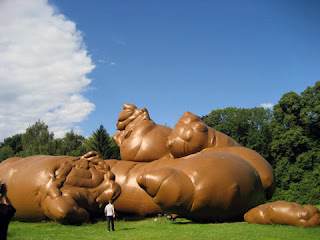
Giant dog turd wreaks havoc at Swiss museum

No comment necessary, but here's a quote (to read, click on the title).

A giant inflatable dog turd created by the American artist Paul McCarthy was blown from its moorings at a Swiss museum, bringing down a power line and breaking a window before landing in the grounds of a children's home.

Philonous: Here's a picture of the offending installation:

Thursday, 7 August 2008

Man on Wire

Le Fox and I on Monday went to see Man on Wire, the story of Phillipe Petit who today in 1974 walked a tightrope strung between the then newly built World Trade Center towers. The film tells the story of the meticulous planning involved, the setbacks, the triumphs. It is a sort of documentary mixed with an action adventure movie with some original footage and other parts acted out with interviews with the main protagonists in the background.

Petit is a French nutcase of the highest order, endowed with the classic one-slice-short-of-a-loaf eyes and the odd maniacal twitch. The footage of him on the wire is truly breathtaking and incredibly beautiful. He even comes across as rather eloquently poetic, if a little bat-shit crazy. Tying the whole thing together are his partners in crime; it was after all illegal as is made clear at every possible opportunity. Ever present is his long suffering and slightly obsessed lover who he seems to have plucked from a life more ordinary aided by his incurable zaniness. With Alistair Darling like hair/eyebrow colour disparity is his rather more sensible friend whose role it was to provide the sanity, though I would argue he fell somewhat short.

It promised to be a gripping and breathtaking thrill ride. It wasn't. The film felt bloated, self obsessed, melodramatic and completely overdone with a ridiculous soundtrack of pretentious semi-ethereal music for which Michael Neimann presumably went to the considerable effort of taping Smooth Classics at Seven. Rather than wasting the cartilage in my fingers, I think I'll leave it to the following scathing review posted on IMDB.

Utterly Pathetic, 3 August 2008,

Author: nickclarkel99 from Ireland

I went into this movie with an open mind but fascinated to find a character who so completely encapsulated everything that i hate. Phillipe Petite and sycophantic friends disgorged their version of events as if they had discovered a cure for aids/cancer/death. I found their admiration of this glorified clown confusing in the extreme, only surpassed in intensity by Phillipe's admiration for himself. Petite manages not only to blow his own trumpet but also the horn, tuba and saxophone. This event seemed primarily concerned in stroking the ego of Phillipe and his desperate aching and repulsive need for approval, probably motivated by a childhood lack from his military father. I eventually felt sorry for Phillipe, though he seemed perfectly happy continuing on, riding even now the wave on his perceived greatness. Though this is like pity for a dog one thinks has a boring life - pointless, Petite is bizarrely fulfilled and to reveal to him the irrelevance of his deed would surely crush his fragile and childlike mind. 1/10

Philonous' verdict: Man on Wire = Crap on Film

Check out the following links if you must: Note: This post may or may not have been deliberately provocative. Let's just say that Le Fox seems to enjoy this movie.

Monday, 28 July 2008

Magnetic Movie

This video is a project from NASA's artists in residence, Semiconductor. As you may imagine (although it took me a little while to realise) all of the magnetic fields drawn in the picture are computer generated rather than physical streams of particles. Having something of an interest in science myself, I wonder what the aim of this artwork is supposed to be, if indeed it has one. There can be no doubt that these magnetic phenomena are incredibly beautiful in many ways, as is most of physics, but is producing such a movie slightly underselling the real science behind these pretty images? Perhaps not. I must admit being a cynic of the first water, but in my mind, this reminded me very much of videos I'd been shown at school in physics lessons or perhaps on BBC2 as part of Open University programmes. There's no doubt that this film is diverting, but in this light, it seems slightly odd for Semiconductor to have been elevated to the status of 'artist'. But then I'm a cynic.

Friday, 18 July 2008

Bearing all

First, a shout-out to my main man Chris who posted a link to this video in a comment after Le Fox's Flying Rats Go Human! post : I think you'll all agree, it's a triumph.

After Le Fox's critique of the slow pervasion of air-rats into urban consciousness (featuring track bike), I suddenly remembered about 2007 Turner Prize winner Mark Wallinger and his film, Sleeper. Check out this video of Wallinger talking about it.

Here are a few links:

Monday, 26 May 2008

Gunther von Hagens (Anatomist)

Today, Le Fox and I were invited, through mere serendipitous fortune, to a question and answer session with the mysteriously eccentric Gunther von Hagens. For those not in the know, the Body Worlds exhibitions have been confronting taboos throughout the world with its sensationalist if not puritanical insistence on public knowledge of anatomical detail since its Japanese inception in 1995. Gunther von Hagens himself is the leading proponent of the concept of a modern renaissance man. He claims:
“The presentation of the pure physical reminds visitors to BODY WORLDS of the intangible and the unfathomable. The plastinated post-mortal body illuminates the soul by its very absence. Plastination transforms the body, an object of individual mourning, into an object of reverence, learning, enlightenment, and appreciation. "I hope for BODY WORLDS to be a place of enlightenment and contemplation, even of philosophical and religious self-recognition, and open to interpretation regardless of the background and philosophy of life of the viewer."
On Saturday night, I found myself in the extraordinary position of inquisitor in a closed session with the progenitor of Body Worlds 4 himself. My question, rather flacidly put, was: "In your exhibition, you quote Descartes' Medations on First Philosophy and allude to Vesalius' groundbreaking discoveries in the field of anatomy, in particular his direct opposition to Galen. Descartes work marked the transition from a scholastic age of philosophy to an age of rationalist foundationalism (and Cartesian dualism), while Vesalius revealed to us fundamental new discoveries relating to that most basic of questions: of what stuff are we made? Where in the history of knowledge do you place yourself, and how do you judge your legacy to future generations?" Of course, this paraphrased piece of nonsense is a dressed up version of the question I would have asked had my inexperience not entirely paralysed me with a mix of awe and stereotypical British politeness. As it was, I asked a messy question along the same lines but put with much less force and sadly lacking in eloquence. He answered rather obliquely, insisting that personal vanity did not enter into Body Worlds.
A plastinated man
Let me put my opinion on Body Worlds in some context. Initially, spurred on by the widespread pubic fervour, I was convinced by a wily Le Fox that it would be an experience not to be missed to see the public airing of Dr von Hagen's most controversial exhibition to date. With considerable misgivings and almost insurmountable cynicism, we made our way to the MoSI, as it has been rebranded, to see what there was to see. Once I'd entered the first of the four or five crowded halls, I was struck by an intense feeling of awe, my gaze settling on installations of carefully arranged muscle and connective tissue. There were certainly cringeworthy moments, not least reading Goethe quoted next to 'Gunter von Hagens (Anatomist)'. (Incidentally, when i put this to him, Dr von Hagens himself seemed noticably to cringe, placing the blame squarely on the shoulders of his wife's design of the exhibition.) I must admit however that the my general experience was overwhelmingly one of wellbeing and a greater awareness of the viscera of which we are, as human beings, composed. Interspersed between the deliberately provocative poses were some truly fascinating invitations to medical science and disease. Comparative displays of normal lungs and livers with those of smokers and drinkers were a graphic health warning and seemed to fulfill one of Dr von Hagen's stated aims of promoting greater body awareness among the general pubic. The rather disappointing truth is that in order to maximise visitor numbers, Body Worlds must rely on sensationalism for its marketing which paints it as anything but serious science. The meeting showed more than anything that Gunther von Hagens is primarily an academic with a passion for anatomy and its public understanding. The success of Body Worlds has had the unfortunate consequence of his message being subsumed by the publicity machine that surrounds him and the rabid commercialism that inevitably followed. Check out these links for more:

Tuesday, 20 May 2008

Guerilla Gardening: resistance is fertile

The other day, Le Fox and I made our way down to Manchester's Urbis to check out their new exhibition on Manga. Having seen the exhibition (which to be honest seemed to be aimed mostly at the emo-kids in the Cathedral gardens outise), we wandered upstairs to kill a little more time. To my pleasant surprise they had an exhibition about Urban Gardening. It seems that I was not alone in my desire for the greening of Manchester's city centre - there were a great many tips for what to grow in confined balconies and window boxes. (No doubt the whole exhibition was a passionate response to Sociomath's Urban Orchards post.) What intrigued me most, however, was a small corner of the exhibition devoted to so called Guerilla Gardening. It seems as though people as despserate for green space as me had decided upon a more pro-active strategy than posting rants on a blog. They instead congregate on what is considered by them to be wasteland and plant trees, herbs, vegetables and flowers in an effort to foster a greater sense of well-being and civic pride among local residents. A couple of years ago, the hallowed airtime of the Beeb itself devoted a moment or two to the notion of guerilla gardening and in particular it's London posterboy, Richard Reynolds: a 30 year old, MG-driving, road-bike riding, well spoken former advertising executive. Have a look at a slightly tongue in cheek seven minute documentary below about guerilla gardening in London.

As for the history of Guerilla gardeining, Wikipedia claims that it started with the True Levellers or Diggers as they became known. These were folk who started gardening on common land and living in cooperatives in the second half of the 17th century. I'd argue that perhaps, since these people were growing food on land that would otherwise have been used to graze cattle that they don't really embody the "pleasant mischeif" mindset of the modern Guerilla gardener. It seems that it all really started (as most vaguely radical movements) in New York in the 1970's with the Green Guerilla group transforming a private derelict lot into a garden. One of the parts of the exhibition which really caught my attention was the concept of 'seed-bombing'. The idea is to be able to plant seeds in relatively inacessible places (behind fences/barbed wire etc). Rather than trying to bypass obstacles, such areas are 'bombed' with lumps of mud and compost containing seeds. By the next year, voila: flowers aplenty! Have a look at this video of some seedbombers in Chicago.

I'm told that there are such orgainisations in Manchester. I know nothing about them. Some links:

Tuesday, 15 April 2008

Adbusters adbusted?

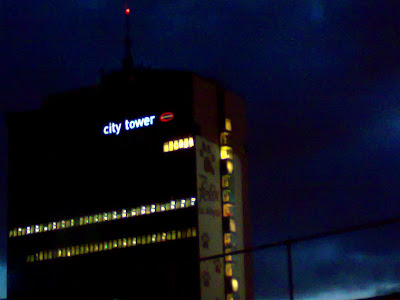
Tonight I was wandering in Manchester city centre as one does when suddenly, a projection appeared on the side of the City Tower in Piccadilly Gardens. Since I'm not in the habit of carrying a camera/tripod with me on my strolls, I had only my mobile phone to take a quick snap. It's slightly hard to see, but there's a projection of a few pawprints and the text "Felix for Mayor".

On returning home, I went online to see if anyone else had noticed what was going on. Searching for the slogan "Felix for Mayor" brought up someone's flickr page with a picture of some advert in what I think is the London edition of Metro. It turns out that this is a publicity stunt by Purina, the multinational corporation responsible for the well known pet food brands Go-Cat, Bakers Complete, Felix as well as my favourite Bonio, no doubt after the eponymous character in Romeo and Juliet's raunchier sequel.

The spontaneity and slightly cobbled together advert reminded me a little bit of so called culture jamming. For those who aren't in the know (like myself until Le Fox kindly filled me in), culture jamming is the process of subverting corporate brands to expose various perceived social injustices. Most culture jammers don't seek to make any sort of profit and so can be seen as somewhere between part time artists and activists, promoting various often radical social perspectives through guerrilla-art. They could perhaps be thought of as media hackers who seek to bring what they think of as balance to capitalism's constant stream of advertising.

Tonight's event was part of a wider program of organised publicity stunts presumably to give the Felix brand a bit of a boost. While adbusting relies on twisting carefully planned and widely established corporate brand images to deliver high impact messages, it would seem that the the quirkiness and spontaneity characterising guerrilla art has been hijacked by a corporation. The social and political messages of culture jamming have been changed into an meaningless and inane phrase supplementing adverts in traditional media.

Seeing this, it occurred to me: has Purina managed to culture jam the notion of culture jamming itself? It would seem that it has.

Some links:

Sunday, 30 March 2008

Picture of the Moment II

Is it just me or does Sundblom Santa look a little bit like Marx? Maybe he had a cutting sense of irony...

Thursday, 27 March 2008

Fashion Obsession

Fashion photographer Scott Schuman, alias "The Sartorialist", is the man responsible for my fashion obsession. His blog has become one of my top priority lunch break activities: eating, checking emails, looking at new updates on The Sartorialist...
Unlike his counterparts who photograph top models in studios, the Sart goes out in New York, Paris and Milan to see what "real" people "really" wear. The subject of his images may be the elites of the fashion industry, eccentric artists or simply image-conscious people.
Verdict: worth checking out. Although it can make you strangely addictive and can make you wonder where these men and women find the time and money to spend on their image.

(Pictures taken from Wikipedia and The Sartorialist)

Wednesday, 26 March 2008

Dot Matrices

Remember those old screetchy printers and the paper with the holes in the edges? Well they seem to be making something of a comeback, albeit in various guises. A couple of years ago I stumbled upon a great project involving dot matrix printers used as synthesisers. Moving the head at different speeds produces different frequencies, so the idea is to computer control a printer to play electronic sounding music. Here's a video with a push-button controller

Thank goodness someone finally harnessed the onerous noise-making capacity of dot matrix printers for good.

Dot matrix printers have also found their way into the world of protest and art in various new forms. In 2004 at the time of the Republican National Convention in New York, a student came up with a mobile dot matrix street writer mounted on a bicycle. The idea was to have people from all over the world write thought proviking slogans on the website and have them instantly written on the pavement somewhere in New York. This "Bike against Bush" was kitted out with a laptop, phone and some sort of GPS device as well as the custom chalk sprayers that made up the printer.

I remember seeing this at the time and decided to check up on the project to see what had happened since. I found the following video about the triumph of American free speech. It turned out that the Feds (or NYPD or someone...well let's just say the man) had been tracking any signs of dissident activity from militant anarchists to church groups and anti-war protesters for a long time before with the intention of apprehending them before they had a chance to protest. Ah, it's the world's favourite democracy in all its characteristic glory.

The latest incarnation of dot matrix printers I've seen recently is Bit.fall by German artist Julius Popp. It's a dot matrix printer for rain! The principle is the same as Bikes against Bush with a whole load of water jets with electronically controlled taps connected to a computer. Perhaps the artist could explain it better himself:

I suppose it's all part of some sort of 80s revival...

Here are some links:

Sunday, 23 March 2008

Picture of the Moment

Not many people realise that Kitchener was inspired by Wittgenstein.

Friday, 11 January 2008

Darkroom!

I've started a darkroom. It's something I've always wanted to do I suppose, but now seemed the time to do it for some reason. Ok. So it's not a proper darkroom, but then again it's not just a dark room... It's a darkroom built for pinhole camera photography! But how does one take photos with a pinhole camera?! It turns out it's actually reasonably simple. The basic principle is as follows. An image is formed in a pinhole camera just as in any other camera so all you have to do is put some film in the right place. The standard darkroom process involves developing your film, then putting the negatives you've just made into an enlarger, projecting them onto photographic paper and then developing the paper. On the film, parts struck by light become dark. The same is true of photographic paper so during the process, the colours are inverted twice, giving you the original again. So, everything is peachy. Well actually no. Enlargers are *really* expensive (the cheapest one I found was about 160 pounds without an enlarging lens, timer easel etc etc etc...). Setting up a darkroom was therefore going to be out of the question. Until I saw podcast about pinhole photography. All you do is stick a pin in a box. Then you have a pinhole camera. So how do you take the photo? Actually, the process is exactly the same as for film except instead of using film, you use photographic paper and instead of using an enlarger, you contact print. For a grand total of 30 pounds I was all set. Watching photos appear is perhaps the coolest thing I've seen for a long time. Highly recommended. To see the podcast, check out: http://blog.makezine.com/archive/2006/08/make_video_podcast_weekend_pro_1.html There are lots of other cool things on the site. I find that actually, his design isnt' all that great. The best thing I've tried so far is a beer can as the container with a hole punched in the side.

Thursday, 13 September 2007

Giotto's World Champion "O"

There's a (probably apocryphal) story that the Pope was thinking of commissioning some painting or other and sent a messenger to Giotto in order to get some sort of proof of his being able to draw. Giotto apparently turned from what he was doing, drew a perfect circle freehand on presumably some sort of paper and handed it to the messenger as proof of his skill. Now you can be world champion circle drawer!

Sunday, 12 November 2006

Axiomatic Sheaf cohomology/Aural Objets Trouves

... Updates, updates... Well, right now I've learnt the axioms of axiomatic sheaf cohomology. Which is nice. The only problem is that everything is rather esoteric at the moment - apparently every fine torsionless resolution of the constant sheaf defines canonically a sheaf cohomology theory. Not only that, but later in the book, it proves that every sheaf cohomology theory is isomorphic for the same choice of the base principal ideal domain K (the sheaves are sheaves of K-modules). This seems nuts right now, but I guess it must be a little less crazy than it sounds. Actually a sheaf cohomology theory seems to be rather a big beastie and so if you pick K as the field of real numbers, the cohomology theory that you get must encapsulate all the classical cohomology theories like de Rham and Cech. Crazy eh? On a lighter note, I found out about an awesome experimental music project called Milkcrate. The idea of the whole thing is to make, I guess, unconventional music. It's awesome. The rules are essentially that all of the objects that you use have to be explicitly non-musical (egg cartons and yoghurt pots?) and they have to all fit inside a standard - presumably Australian - milkcrate. Oh, and it all has to be completed in 24 hours. It seems to me that this is bringing the idea of objets trouves to music in a whole new electronic way. Hurrah for the internet! (see http://www.milkcrate.com.au/)