I thought I'd write a quick little ditty about a bit of music with which I have been strangely obsessed ever since we sang it in the Burlington Choir a couple of months ago. It's a piece by Thoinot Arbeau (1519-1595), real name Jehan Tabourot originally written as an instrumental dance. Apparently Arbeau was a master of dances and wrote the definitintive book on Renaissance dance, the Orchésographie from which much of modern knowledge about the period is derived. The pavane Belle qui tiens ma vie is I think one of the very few pieces in the Orchésographie with all four parts filled in by Arbeau himself, the others having only the top line. Here's a facsimile of the relevant pages and here's a modern version.
Perhaps because all of the original parts are included, this seems to have sparked off a great number of people with their own versions. The one which strikes me as most like an actual dance is that of The Broadside Bandand excerpt of which I couldn't find online, but which is being played in the background of this YouTube video. What follows are a load of versions which get progressively... well I'll let you decide. Check out:Friday, 12 September 2008
Wednesday, 23 July 2008
Roots (disambiguation)
In Euclidean Space:
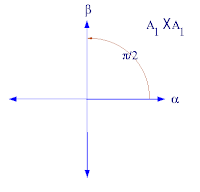
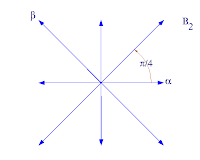
Let V be a finite-dimensional Euclidean space, with the standard Euclidean inner product denoted by . A root system in V is a finite set Φ of non-zero vectors (called roots) that satisfy the following properties:
- The roots span V.
- The only scalar multiples of a root α ∈ Φ that belong to Φ are α itself and −α.
- For every root α ∈ Φ, the set Φ is closed under reflection through the hyperplane perpendicular to α. That is, for any two roots α and β, the set Φ contains the reflection of β in the plane perpendicular to α.
- (Integrality condition) If α and β are roots in Φ, then the projection of β onto the line through α is a half-integral multiple of α.
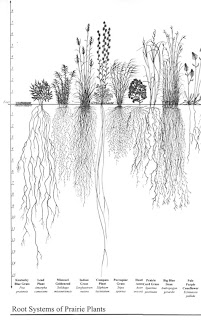
In vascular plants, the root is the organ of a plant body that typically lies below the surface of the soil. But, this is not always the case, since a root can also be aerial (that is, growing above the ground) or aerating (that is, growing up above the ground or especially above water). On the other hand, a stem normally occurring below ground is not exceptional either (see rhizome). So, it is better to define root as a part of a plant body that bears no leaves, and therefore also lacks nodes. There are also important internal structural differences between stems and roots. The two major functions of roots are 1.) absorption of water and inorganic nutrients and 2.) anchoring the plant body to the ground. Roots also function in cytokinin synthesis, which supplies some of the shoot's needs. They often function in storage of food. The roots of most vascular plant species enter into symbiosis with certain fungi to form mycorrhizas, and a large range of other organisms including bacteria also closely associate with roots.
On TV:
Roots is a 1977 American television miniseries based on Alex Haley's work Roots: The Saga of an American Family, his critically acclaimed but factually disputed genealogical novel.
In the Charts:
Roots is the sixth studio album by Brazilian thrash metal band Sepultura, released in 1996 through Roadrunner Records. It was the band's last album to feature Max Cavalera. The majority of the themes presented on Roots are centered on Brazilian politics and culture.
The inspiration for Sepultura's new musical directon was two-fold. One was the desire to further experiment with the music of Brazil, especially the percussive type played by Salvador, Bahia samba reggae group Olodum. A slight influence of Northeastern Brazil's native music is also present in the guitar riffs, especially baião and capoeira music. Another innovation Roots brought was the inspiration taken from the (then) cutting-edge nu metal sound of the Deftones and KoЯn - especially the latter's debut, with it's heavily down-tuned guitars.
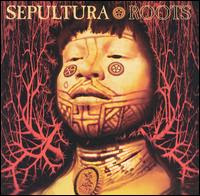
Roots was released in February 1996 and received with unprecedented enthusiasm. Even the popular press, that usually doesn't pay a lot of attention to metal records, halted the presses to appreciate the unusual rhythms mixture of Sepultura. American newspapers like The New Times, the Daily News[disambiguation needed] and the Los Angeles Times reserved some space for the Brazilian band: "The mixture of the dense metal of Sepultura and the Brazilian music has a intoxicating effect", wrote a Los Angeles Times' reviewer. The Daily News went even further: "Sepultura reinvented the wheel. By mixing metal with native instruments, the band resuscitates the tired genre, reminding of Led Zeppelin times. But while Zeppelin mixed English metal with African beats, it's still more moving to hear a band that uses elements of its own country. By extracting the sounds of the past, Sepultura determines the future direction of metal".
Acknowledgements: This post would not have been possible without the untiring effort of all of those kind folk at Wikipedia who are up at all hours of the day and night writing entries. I'd also like to thank they keys Ctrl, C and V
Sunday, 20 July 2008
Warsaw: From the Stare Miasto to the Pałac Kultury i Nauki
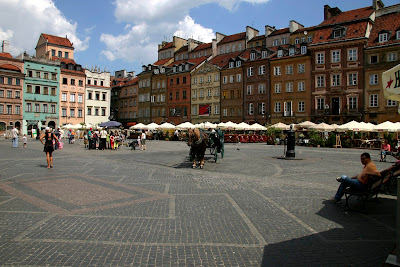
The lover of mind has landed in Warsaw. This city is extraordinarily beautiful, green and without blemish. From the old town which was rebuilt after having been destroyed during the second world war, to the grandiose 43 storey stamp of the Pałac Kultury i Nauki, one can't help but be impressed by it all. I'm staying in a very lovely hotel just south of the city centre next to a grand park and all of the various embassies. From there i was advised (by folk in the know) to go to the old town (Stare Miasto) to have a look at all of the lovely old (new) Polish buildings. During the second world war, Warsaw was essentially gutted. Most of the historic buildings were completely destroyed and the old town centre was rebuilt from scratch.
Wandering around European cities, one becomes accustomed to the sight of buildings which if not exactly crumbling, show all of their three hundred or so years. Here everything comes across a little bit Disney. The entire old town is so incredibly pristine that rather than being 300 years old, most buildings look as if they have travelled through time. I wouldn't be surprised if the whole Stare Miasto was injection moulded in one piece from fadeproof plastic in a Detroit factory and shipped over as part of some covert Marshall plan. It's a great shame that so much of this great city was destroyed in the carnage of 1939-45.
Still imposing upon the skyline is Stalin's great stamp of authority, the Pałac Kultury i Nauki-a full blown propaganda factory mass producing and distributing Soviet pronouncements in the form of films, books, plays and exhibitions. Now though, the huge tower is somewhat eclipsed by the skyscraping testaments to Poland's new legacy. Viewed from one side, the Stalinist face of hard nosed totalitarianism is still there to be seen. Viewed from the others, the huge Carlsberg parasols, the brightly coloured advertisments and the various other skyscrapers peer over Stalin's long-dead message. Perhaps even more ironically, underneath one face is a massive skate park full of teenagers humming Green Day and periodically rescuing their trousers from the ever present clutches of gravity. If you look carefully at the right hand photo, you might just be able to see on the left the massive cuboid of the Intercontinental along with various other skyscrapers belonging to foreign banks. The man of steel would turn is his grave.Monday, 23 June 2008
BM est. 1759
Finally, since I am in London after all, I thought it only right that I visit the British Museum. The first time i walked into this building, I didn't quite know what to expect. The huge classical colonade gives way at the entrance to a dark foyer flanked by the giftshop and a couple of galleries. I remember thinking that it would be full of very stuffy old men looking at very stuffy old exhibitions which would be nothing more than the trophy cabinets of dead merchant soldiers. Thursday, 3 April 2008
Avicenna's Argument
Avicenna was apparently one of the most important polymaths in the so called "Golden Age of Islam". He lived in Persia from 980 to 1037 and was renowned in many fields of knowledge, even to the extent that one of his textbooks on medicine was still used as the core text in Montpellier and Louvain in the mid 17th century.
One of the great ideas of Avicenna was his argument for the existence of God which, to me at least, smacks very much of mathematical proof (and is therefore understandably quite appealing to one such as myself...). So, what's it all about?
Avicenna uses heavily the concept of contingency. A state of affairs is contingent if it could have been otherwise. So for instance, my mother at some point had a child: me. It was by no means a logical necessity that she do this - I might not have been born. Therefore my existence is contingent upon the fact my parents decided to have a child. Similarly their existence is contingent upon their parents having had children, and so on... Avicenna's argument tries to construct a necessary object and then calls that God.
Ok. So the world contains a great many contingent things (like me for instance). The existence of each one of these things must therefore have been caused by something else which is itself contingent and so on and so forth... Such and such a table was made by a carpenter whose existence was caused by his father and mother etc. So we get a big long causal chain of events which are all contingent. The usual (cosmological) argument for the existence of God says at this point that this chain must stop somewhere so we get an 'uncaused causer', which is taken to be God.
Avicenna comes up with a slightly subtler approach. He basically defines 'the world' as the set of all contingent things and all the causes between them. He then states a principle of composition which, applied here, says that the set of all contingent things is also contingent. Since the world is therefore contingent, it must be caused by some object X outside the world. Suppose X is contingent. Then it must be part of the world, which is impossible. Therefore X was in fact not contingent, i.e. necessary. He defines this X to be God.
Of course, as with any argument for the existence of God, there are quite a few problems with this:
- What justification do we have that anything is contingent in the first place?
- How do we know that this X is the God of (in Avicenna's case) Islam as opposed to just some abstract object? That is, how do we arrive at any of the traditional attributes of God such as omnipotence etc.?
- What's all this principle of composition about? Admittedly, if I have a car, all of whose components are blue, then my car will be blue. But if I have a car, all of whose components are well made, then it's certainly not true that the car itself must be well made.
Flame from lamp (A) catches on curtain (B) and fire department sends stream of water (C) through window. Dwarf (D) thinks it is raining and reaches for umbrella (E), pulling string (F) and lifting end of platform (G). Iron ball (H) falls and pulls string (I), causing hammer (J) to hit plate of glass (K). Crash of glass wakes up pup (L) and mother dog (M) rocks him to sleep in cradle (N), causing attached wooden hand (O) to move up and down along your back.
Thursday, 13 September 2007
Giotto's World Champion "O"
There's a (probably apocryphal) story that the Pope was thinking of commissioning some painting or other and sent a messenger to Giotto in order to get some sort of proof of his being able to draw. Giotto apparently turned from what he was doing, drew a perfect circle freehand on presumably some sort of paper and handed it to the messenger as proof of his skill. Now you can be world champion circle drawer!
Thursday, 3 August 2006
Algeria: From pre-history to the pieds-noirs
Algeria, it seems, has a rather rich history, full of stories of Berber tribes and kingdoms, subjugated by empire after empire before the French, caught up in a rivalry and politically induced nationalistic fervour, assimilated Algeria into the departements.
In the abyss of prehistory, hominids and humans flourished in various areas of Algeria. The earliest archeological evidence of inhabitants of Algeria dates from as far back as 1.8 million years, but more substantial tracts of toolmaking and hunting dates from around 30,000 years ago. Blade-making flourished in the area around Oran, and spread to the surrounding regions between 15,000 and 10,000 BC. These early peoples eventually coalesced into what became the Berbers. The Berbers were a people primarily brought together by similar languages and customs and were considered by classical scholars to be an unruly and barbarian people. This view is however entirely unfounded and may be thought of as propaganda by invading forces. The first foreign powers to extablish a foothold in north Africa were the Phoenicians. These were Canaanite people living along the coast of what constitutes modern day Lebanon and trading extensively throughout the Mediteranean by means of a fleet of galleys.Sunday, 30 July 2006
Thomas Lovell Beddoes (1803-1849)
My attention was drawn to this most macabre of poets by a programme in the series on poetry societies on Radio 4. He seems to have led a rather colourful life, being born in Bristol in 1803 into the relatively well off family of Dr Thomas Beddoes, a famous physician. The origins of his taste for the gothic may be traced to a fascination with the dissections performed in the house in the name of scientific enquiry. His early years are characterized by intelligence and a flair for the literary accompanied by disruptiveness and rebelliousness. Having studied at Pembroke College Oxford, writing plays and poetry while he was there, Beddoes was on the brink of a successful literary career as a romantic poet when he left for Germany. Some cite a homosexual's desire for anonymity as his reason for leaving, but this remains an open question.
In Germany, his literary studies were replaced by anatomy and medicine. His involvement in radical politics, drunken and disorderly behaviour and general troublemaking caused his being expelled from various universities and states. On his travels, he continued his writing however and produced his celebrated work "Death's Jest-book".
His life had always been plagued by intermittent bouts of alcoholism and depression. In 1848, such an occasion resulted in an attempted suicide in which Beddoes cut open his own femoral artery with a dissecting scalpel. The wound was in fact not fatal, but led to the amputation of his leg, variously attributed by him in letters to his family as the result of a riding injury and accidental injury sustained during a dissection. The following year, he finally ended his life once and for all, taking poison and pinning the following characteristically black and eccentric suicide note (to his solicitor in London) to his jacket.
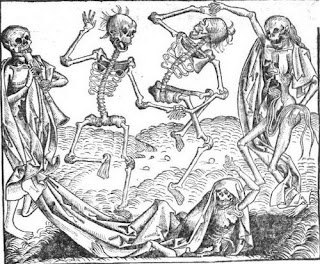
My Dear Phillips I am food for what I am good for - worms. I have made a will here which I desire to be respected - and add the donation of ₤20 to Dr Ecklin my physician - W. Beddoes must have a case (50 bottles - ) of Champagne Moet 1847 growth to drink my health in Thanks for all kindnesses Borrow the ₤200 You are a good & noble man & your children must look sharp to be like you. Yours if my own, ever, T. L B Love to Anna Henry - the Beddoes of Longvill and Zoe & Emmeline King - also to Kelsall whom I beg to look at my MSS and print or not as he thinks fit. I ought to have been among other things a good poet; Life was too great a bore on one peg & that a bad one. - Buy for Dr Ecklin above mentioned ReadeÂs best stomach-pumpHis poetical works have mustered an underground following for many years, but only recently was he embraced by the literary pantheon as a romantic poet. Tim Burton lists Beddoes among his influences and a cursory glance at both of their repsective work makes clear the influence.
Related Links: A set of links to his various works and biographies - http://www.litgothic.com/Authors/beddoes.htmlThursday, 27 July 2006
Akademia
Society, it seems, has always found a place for the eccentric. Swaddled in philosophy and drifting seamlessly through the ether of erudition, he trips and stumbles through life's more mundane and necessary tasks. In academia lies the only repose. Those red brick sanatoria for the gifted but incapable are at the same time bastions of learning and shelter from the tangible and concrete.
The other day, I came upon the origins of the word academia and academic. They are derived from Plato's academy (cited by some have been founded long before Plato), which, rather than being the great marble hall of Raphael's imagining, was in fact more of a walled public park. It seems that the academy began as a series of impromptu meetings of various of the ancient lovers of knowledge to discuss ideas away from the hubbub of the necessary. The site contains various temples and was the setting for various games involving men racing along narrow tracts between altars. Plato's school took its name from the area of Athens in which the meetings took place. This in turn is derived from the name of the Attic hero Hekademus, which was corrupted first into Akademus and then into Academus. Apparently, Helen of Troy was originally a girl from Argos who at the age of 12 was carried of by Theseus (of golden fleece fame) and Pirithous, who were otherwise good men. Having won the lots they took to decide who would marry her, Theseus then hid her in Aphidnae under the care of his mother. In the process of trying to find Pirithous a wife, Theseus was imprisoned and Pirithous killed. In the mean time, rescuers were searching for Helen in vain until...
"Akademus, who had by some means discovered that she was concealed at Aphidnae, now told them where she was; for which cause he was honoured by the sons of Tyndareus during his life, and also the Lacedaemonians, though they often invaded the country and ravaged it unsparingly, yet never touched the place called the Akademeia, for Akademus' sake." XXXII, Plutarch's Lives, Volume I (of 4)
(For the full text, check out project Gutenberg)
The park in which Plato and the other philosophers met was indeed by tradition, the same land given to Akademus to form the Akademia. Thank goodness then for our own little slices of Akademia, be they parks with marble temples or edifices of brick and concrete.