
 The other day, Le Fox and I made our way down to Manchester's Urbis to check out their new exhibition on Manga. Having seen the exhibition (which to be honest seemed to be aimed mostly at the emo-kids in the Cathedral gardens outise), we wandered upstairs to kill a little more time.
To my pleasant surprise they had an exhibition about Urban Gardening. It seems that I was not alone in my desire for the greening of Manchester's city centre - there were a great many tips for what to grow in confined balconies and window boxes. (No doubt the whole exhibition was a passionate response to Sociomath's Urban Orchards post.)
What intrigued me most, however, was a small corner of the exhibition devoted to so called Guerilla Gardening. It seems as though people as despserate for green space as me had decided upon a more pro-active strategy than posting rants on a blog. They instead congregate on what is considered by them to be wasteland and plant trees, herbs, vegetables and flowers in an effort to foster a greater sense of well-being and civic pride among local residents.
A couple of years ago, the hallowed airtime of the Beeb itself devoted a moment or two to the notion of guerilla gardening and in particular it's London posterboy, Richard Reynolds: a 30 year old, MG-driving, road-bike riding, well spoken former advertising executive. Have a look at a slightly tongue in cheek seven minute documentary below about guerilla gardening in London.
The other day, Le Fox and I made our way down to Manchester's Urbis to check out their new exhibition on Manga. Having seen the exhibition (which to be honest seemed to be aimed mostly at the emo-kids in the Cathedral gardens outise), we wandered upstairs to kill a little more time.
To my pleasant surprise they had an exhibition about Urban Gardening. It seems that I was not alone in my desire for the greening of Manchester's city centre - there were a great many tips for what to grow in confined balconies and window boxes. (No doubt the whole exhibition was a passionate response to Sociomath's Urban Orchards post.)
What intrigued me most, however, was a small corner of the exhibition devoted to so called Guerilla Gardening. It seems as though people as despserate for green space as me had decided upon a more pro-active strategy than posting rants on a blog. They instead congregate on what is considered by them to be wasteland and plant trees, herbs, vegetables and flowers in an effort to foster a greater sense of well-being and civic pride among local residents.
A couple of years ago, the hallowed airtime of the Beeb itself devoted a moment or two to the notion of guerilla gardening and in particular it's London posterboy, Richard Reynolds: a 30 year old, MG-driving, road-bike riding, well spoken former advertising executive. Have a look at a slightly tongue in cheek seven minute documentary below about guerilla gardening in London.
Tuesday, 20 May 2008
Guerilla Gardening: resistance is fertile


Tuesday, 13 May 2008
The Brazil Nut Effect
Ever wondered why on packets of cereal it sometimes says something to the effect of "Please turn packet on its side to redistribute nuts evenly"? I'd always thought that this was because any of the larger particles would have sunk to the bottom. It turned out that this was in fact not the case. Yesterday was the day of the MRSC08 conference for postgraduate maths students in Manchster. One of the talks explained the so called "Brazil nut effect", the phenomenon of larger nuts rising to the top of packets of mixed nuts during transport. The following video (taken from here) shows the effect working on a brass cylinder among polystyrene foam beads.
It turns out that although gravity pulls the cylinder down relative to the polystyrene, there are granular flow effects that also push the cylinder up which are far greater than expected. I can't claim to be an expert, but the talk was incredibly interesting. (See Prof. Nico Gray's website for research about granular flows in Manchester).
Here's a slow motion version of the above video to maybe give some intuitio for what's going on. I have to admit, I still don't quite understand from where the upward force comes.
Friday, 9 May 2008
A musical Offering
You're listening to:
- Chop Suey! - System of a Down
- Dirge - Death in Vegas
- Filmstar - Suede
- One Way - Levellers
- Dusted - Leftfield
- Sympathique - Pink Martini
- Black Hole Sun - Soundgarden
- Over the hills and far away - Led Zeppelin
- Perpetuum Mobile - Penguin Café Orchestra
- Neighbourhood - Space
Monday, 5 May 2008
Mathematical duality
Let me set the scene. A brooding overcast morning in post-industrial Manchester. A Mancunian café underneath an old railway arch. Two large lattés. On my side of the table a physics book for mathematicians, on Le Fox's the Economist. I opened my book on at a chapter on the basics of quantum mechanics. It stated:
"A description of physical reality is made in terms of two set of objects: observables and states. A set of obsevables A, B,... will be denoted by A and states w, x, y,... by W. Each state assigns to each observable its probability distribution on the real line. This pairing (mean value) defines a duality between A and W."
Definition: The universe is a four dimensional affine space.Which was perhaps inspired by Wittgenstein's
1 The world is all that is the case 1.1 The world is the totality of facts, not of things. etc.In any case, I started to wonder about the notion of duality. In mathematics at least, duality seems to be reasonably well defined. The modern idea I suppose started with the idea of a vector space having a dual which might have been somehow inspired by duals of platonic solids through the reflexive property of taking duals (at least for finite dimensional spaces). But then there's also Poincaré duality for compact oriented manifolds which says that the kth and (n-k)th Betti numbers are equal (for coefficients in Z2, orientability isn't required).

Friday, 2 May 2008
The Ontology of Blogging
I stumbled upon this great Rocketboom video of Dave Weinberg giving a talk on mass media and blogging. Enjoy!
Thursday, 1 May 2008
Artificial Ball lightning
A few years ago, a friend of mine and I decided to try and create artificial ball lightning in a microwave. All you need is a grape, a microwave and a knife.
- Cut the grape in half so that there is only small piece of skin attaching the two halves together and they look like a pair of bongo drums.
- Take the tray out of your microwave.
- Put the grape in your microwave with the wet faces up.
- Start the microwave and have your finger on the stop button.
 I'm not totally sure the physics behind the whole thing. The explanation my friend had was that the microwave sets up a standing wave inside the microwave which has around the right wavelength to create a big potential difference between the two grape surfaces. Eventually, as some of the water in the grapes boils, steam is ejected. In the presence of such a large potential difference, this ionises and forms a plasma for a split second. I'm still not totally convinced that this is actually what's going on, but I have no better explanation.
It turns out that it works even better when you have a flame in your microwave. The gas in the flame ionizes very easily and it's even possible to contain the plasma in a vessel of some sort for some time. Here's a video of someone trying it with a match:
Here's what I think happens:
The microwave keeps giving electrons in the hot gas enough energy to escape their nuclei. When these electrons return, they give off a load of energy in the form of electromagnetic radiation, some of which is the light you see. Presumably different burning materials give different parts of the characteristic spectrum (and so different colours...)
Le Fox, I would guess that if your chimney is struck by lightning when you have a fire in the fireplace, much the same things happens...
I could well be wrong...
See here for a good explanation of a similar grape experiment (with diagrams!).
Wednesday, 30 April 2008
Foudre en boule


Another advice my Grandmother gave me about thunderstorms is: "In case you're walking outside and there is lightning, wear nothing but a silk scarf and you'll be safe." If you decide to try it, send me a picture ;-)
Tuesday, 29 April 2008
Farm life
One of my favorite times on the farm when I was little was when the power would go out. It was such an adventure! We had a wood burning stove in our house, so we could still see, stay warm, and cook. It was such a novelty to put the pan on top of the stove just like they did in the olden days. We would usually cook something out of a can as it was easy. I remember feeling very industrious and pleased to live on a farm, because that meant that we could survive anything! We had all the tools and supplies we needed. Living in the city now is the complete opposite, just like Philonous said, you look around and realize how entirely vulnerable you are. Imagine just trying to get out of the building and having to rush down 7 flights of stairs- what if the door wouldn't open because the buzzer was off? Our urban societies are much more fragile than we think.
Saturday, 26 April 2008
Power Cut
Earlier this evening, the electricity supply for some reason cut out. I was at the time surfing the web on a laptop so the instant the power went off, the network connection disappeared. Having fumbled around the house for matches for a while, I finally managed to light a candle which for once wasn't being used for ambience. It suddenly occurred to me that without electricity it would be essentially impossible to survive in my flat. Being relatively new, my home depends exclusively on electricity for energy. From heating to cooking, everything in the house is plugged into the wall in some way.
 I had been planning to heat up some leftovers in the microwave. But now I couldn't use a microwave. Or a toaster. Or the oven. In fact, I couldn't eat any raw food at all - it was lucky that there were some leftovers, however cold. Sitting on the couch, swaddled in a duvet against the dwindling warmth, it occurred to me that by the next morning any remaining hot water in the tank would have cooled and anything in the freezer would have started to defrost. My only consolation was in reading a book by the flickering light of a couple of candles.
No wonder Russia weilded so much power over the Ukraine when it came to energy supplies. There has been so much publicity over the rising cost of energy in general, but we at least still have access to energy, however expensive it may be.
And then the lights came on again.
I had been planning to heat up some leftovers in the microwave. But now I couldn't use a microwave. Or a toaster. Or the oven. In fact, I couldn't eat any raw food at all - it was lucky that there were some leftovers, however cold. Sitting on the couch, swaddled in a duvet against the dwindling warmth, it occurred to me that by the next morning any remaining hot water in the tank would have cooled and anything in the freezer would have started to defrost. My only consolation was in reading a book by the flickering light of a couple of candles.
No wonder Russia weilded so much power over the Ukraine when it came to energy supplies. There has been so much publicity over the rising cost of energy in general, but we at least still have access to energy, however expensive it may be.
And then the lights came on again.
Friday, 25 April 2008
Technology- amazing.
Just saw an article in the Guardian that made me marvel at technology (how old do I sound?) There is an idea to put 'under floor heating' beneath road surfaces, but heating that is powered by solar energy, collecting it during the hot summer to melt ice in the winter and improve driving conditions. Wow. Now that's a good idea, and I hope it works.
 Read more here
Thursday, 24 April 2008
I love you Google...
I'm glad I've got a google account (thanks to this blog) because now I've set up my iGoogle page, which is clever on their part, so now each day I'm greeted by new art, quotes, and words to ponder on. I never thought it would be so easy to enrich my life- it really seems like cheating. But here is a quote to start:
Monday, 21 April 2008
Save the animals - buy fur.
 I must admit, the thought of buying fur makes me feel slightly queasy. I have no explanation for this other than an emotional response triggered by many years of exposure to the anti-fur movement's advertising. On the face of it, farmed fur really is a pretty horrible thought. Animals raised in captivity in terrible conditions just so that folk can be dressed from head to toe like someone from Dr Zhivago. Now that synthetic materials are avalailable which perhaps offer better protection against the elements than mother nature, it really does seem rather a cruel and distasteful fashion accessory.
I was amazed therefore to read of fur as being marketed by various organisations as an 'eco-friendly' product. According to Canada's Fur Council. Their website in the optimistically titled 'Fur is Green' section argue that fur is a renewable resource and is fully biodegradable (as opposed to fake fur which is make from petroleum byproducts). Indeed they seem to imply that they are somehow in tune with (and I quote) 'the circle of life', calling it 'the ultimate eco-clothing'. I can see hundreds of hippies wandering round in bear-skin Birkenstocks right now...
I must admit, the thought of buying fur makes me feel slightly queasy. I have no explanation for this other than an emotional response triggered by many years of exposure to the anti-fur movement's advertising. On the face of it, farmed fur really is a pretty horrible thought. Animals raised in captivity in terrible conditions just so that folk can be dressed from head to toe like someone from Dr Zhivago. Now that synthetic materials are avalailable which perhaps offer better protection against the elements than mother nature, it really does seem rather a cruel and distasteful fashion accessory.
I was amazed therefore to read of fur as being marketed by various organisations as an 'eco-friendly' product. According to Canada's Fur Council. Their website in the optimistically titled 'Fur is Green' section argue that fur is a renewable resource and is fully biodegradable (as opposed to fake fur which is make from petroleum byproducts). Indeed they seem to imply that they are somehow in tune with (and I quote) 'the circle of life', calling it 'the ultimate eco-clothing'. I can see hundreds of hippies wandering round in bear-skin Birkenstocks right now...
 A slightly more serious claim to environmental responsibility in relation to fur is New Zealand's possum fur industry. Though quite cute, possums are considered eco-system destroying pests across New Zealand since their numbers have grown beyond all expectations. The trapping and poisoning of possums is in fact encouraged by the government in an attempt to preserve natural habitats from dessimation by these marsupials which were artificially introduced around 150 years ago. Amazingly, conservation organisations such as the WWF have endorsed the possum fur industry as essential for maintaining biodiversity.
Sunday, 20 April 2008
Writer's block and favourite poem
 I thought it would be nice to post my favourite poem. It was composed by the German dada artist Kurt Schwitters. It is a love poem that doesn't make sense (a translation is posted after the original):
o du, geliebte meiner siebenundzwanzig sinne, ich liebe dir! - du deiner dich dir, ich dir, du mir. - wir? das gehört (beiläufig) nicht hierher. wer bist du, ungezähltes frauenzimmer? du bist - bist du? - die leute sagen, du wärest - laß sie sagen, sie wissen nicht, wie der kirchturm steht. du trägst den hut auf deinen füßen und wanderst auf die hände, auf den händen wanderst du. hallo, deine roten kleider, in weiße falten zersägt. rot liebe ich anna blume, rot liebe ich dir! - du deiner dich dir, ich dir, du mir. - wir? das gehördt (beiläufig) in die kalte glut. rote blume, rote anna blume, wie sagen die leute? preisfrage: 1. anna blume hat ein vogel. 2. anna blume ist rot. 3. welche farbe hat der vogel? blau ist die farbe deines gelben haares. rot ist das girren deines grünen vogels. du schlichtes mädchen im alltagskleid, du liebes grünes tier, ich liebe dir! - du deiner dich dir, ich dir, du mir - wir? das gehört (beiläufig) in die glutenkiste. anna blume! anna, a-n-n-a, ich träufle deinen namen. dein name tropft wie weiches rindertalg. weißt du es, anna, weißt du es schon? man kann dich auch von hinten lesen, und du, du herrlichste von allen, du bist von hinten wie von vorne: "a-n-n-a." rindertalg träufelt streicheln über meinen rücken. anna blume, du tropfes tier, ich liebe dir! (Kurt Schwitters, An Anna Blume)
This poem has also inspired the German hip-hop band Freundeskreis:
I found this translation on http://www.jbeilharz.de/expr/expr_poems.html. Unfortunately the complex German grammar which Kurt Schwitters plays with in this poem cannot be translated into English.You, oh you, beloved of my twenty-seven senses, I love ya! - You thine thou yours, I you, you me. - Us? This (incidentally) does not belong here. Who are you, countless woman? You are - are you? - People say you are - let them say it, they don't know where the steeple is. You wear a hat on your feet and stand on your hands, on your hands you walk. Hello, your red clothes, sawed into white pleats. Red I love, Anna Blume, red I love ya! - You thine thou yours, I you, you me. - Us? That (incidentally) belongs in the cold embers. Red flower, red Anna Blume, what are people saying? Prize question: 1. Anna Blume has a bird. 2.Anna Blume is red. 3.What color is the bird? Blue is the color of your yellow hair. Red is the cooing of your green bird. You plain girl in an everyday dress, you dear green animal, I love ya! - You thine thou yours, I you, you me - us? That (incidentally) belongs in the ember box. Anna Blume! Anna, a-n-n-a, I am dripping your name. Your name drips like soft suet. Do you know, Anna, do you know yet? You can also be read from back to front, and you, you most marvelous creature of them all, you are from the back as you are from the front: »a-n-n-a.« Suet drips caress my back. Anna Blume, you droppy animal, I love ya!
Saturday, 19 April 2008
Are you people or sheeple?!
Yesterday, I watched the "What would Jesus Buy?", a documentary following the Church of Stop Shopping Gospel Choir on its tour around the USA.
 The centre of the film is the charismatic Reverend Billy who urges devotees to stop shopping and turn around the consumer culture which they see as a marketing-driven addiction. He and his gospel choir preach and sing their message to various people around the USA in a protest against gentrification and large corporations.
I found the film entertaining enough, but was never totally sure whether there was a religious aspect to Rev. Billy or whether this was all a humorous package for a serious message. Check out the trailer:
The centre of the film is the charismatic Reverend Billy who urges devotees to stop shopping and turn around the consumer culture which they see as a marketing-driven addiction. He and his gospel choir preach and sing their message to various people around the USA in a protest against gentrification and large corporations.
I found the film entertaining enough, but was never totally sure whether there was a religious aspect to Rev. Billy or whether this was all a humorous package for a serious message. Check out the trailer:
Wednesday, 16 April 2008
100 hat solution


The idea really isn't complicated at all - if it seems so, then I've explained it badly. First of all, knowing if a hat is white or not is equivalent to knowing its colour since there are only two. The first person to go counts up the number of white hats he can see in front of him. If it's odd, he shouts 'white' and if it's even, he shouts 'black'. Prisoner number 2 then counts the number of white hats in front of him. He then figures out if it's odd or even. We know that
- (odd number) - (odd number) = even number
- (odd number) - (even number) = odd number
- (even number) - (odd number) = odd number
- (even number) - (even number) = even number
Prisoner 2 can use prisoner 1's shout as the first number and his own tally as the second. This spits out something on the right hand side. If he gets 'even' he shouts black, if he gets 'odd' he shouts white. Prisoner 3 has heard prisoner 1 and 2 and also knows whether the number of hats in front is even or odd. He then does a similar calculation and shouts out the right answer...and so on.
Perhaps this isn't perfectly explained. Never mind.
Tuesday, 15 April 2008
Adbusters adbusted?
Tonight I was wandering in Manchester city centre as one does when suddenly, a projection appeared on the side of the City Tower in Piccadilly Gardens. Since I'm not in the habit of carrying a camera/tripod with me on my strolls, I had only my mobile phone to take a quick snap. It's slightly hard to see, but there's a projection of a few pawprints and the text "Felix for Mayor".
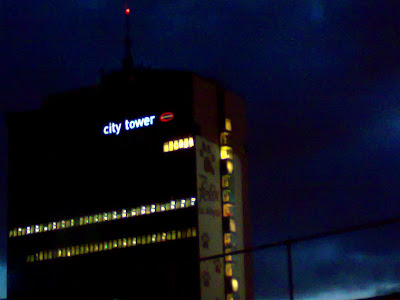 On returning home, I went online to see if anyone else had noticed what was going on. Searching for the slogan "Felix for Mayor" brought up someone's flickr page with a picture of some advert in what I think is the London edition of Metro. It turns out that this is a publicity stunt by Purina, the multinational corporation responsible for the well known pet food brands Go-Cat, Bakers Complete, Felix as well as my favourite Bonio, no doubt after the eponymous character in Romeo and Juliet's raunchier sequel.

The spontaneity and slightly cobbled together advert reminded me a little bit of so called culture jamming. For those who aren't in the know (like myself until Le Fox kindly filled me in), culture jamming is the process of subverting corporate brands to expose various perceived social injustices. Most culture jammers don't seek to make any sort of profit and so can be seen as somewhere between part time artists and activists, promoting various often radical social perspectives through guerrilla-art. They could perhaps be thought of as media hackers who seek to bring what they think of as balance to capitalism's constant stream of advertising.
Tonight's event was part of a wider program of organised publicity stunts presumably to give the Felix brand a bit of a boost. While adbusting relies on twisting carefully planned and widely established corporate brand images to deliver high impact messages, it would seem that the the quirkiness and spontaneity characterising guerrilla art has been hijacked by a corporation. The social and political messages of culture jamming have been changed into an meaningless and inane phrase supplementing adverts in traditional media.
Seeing this, it occurred to me: has Purina managed to culture jam the notion of culture jamming itself? It would seem that it has.
Some links:
Monday, 14 April 2008
Urban Orchards
After living in the Manchester's city centre for a couple of months you start to notice that something is amiss. In the back of your mind, there is something that itches away relentlessly. No matter how hard you try, you just can't put your finger on it...until...
There aren't any parks!
Ok. That's not strictly true. According to MEN, there are various green spaces to which you can slink away to "eat your lunch or take a break from a hard day's shopping", but anyone who lives in the centre knows that these rarely measure more than 3ft across and are normally surrounded by busy roads. Should anyone find a viable park in the city centre, please do let me know.
 Various cities have tried to combat the slow decline into a concrete jungle, perhaps most notably Singapore with its garden city drive since the 60s. LA has tried similar approach with its Million Trees initiative which aims to clear some of the pollution as well as providing some shade for residents.
One great programme that has caught my attention recently is the Fruit Tree Tour through California. The poor quality of the diets of children worldwide has been a prominent source of controversy recently with government reports and a media frenzy attributing behavioural problems to deficiencies in diversity of food consumed. Apparently, only 11% of Californian children are getting their recommended daily allowance of fresh fruit and vegetables. The Fruit Tree Tour aims to tackle both this statistic and lack of greenery in cities by planting fruit trees. These urban orchards will provide fruit for local people as well as focussing communities on self sufficiency, ecology and various other noble (trendy?) causes. I think its an absolutely brilliant idea, though I'm not sure I'm totally in tune with the 'Mother Earth' songs they seem to be teaching all of the kids... Check out their promotional video:
Various cities have tried to combat the slow decline into a concrete jungle, perhaps most notably Singapore with its garden city drive since the 60s. LA has tried similar approach with its Million Trees initiative which aims to clear some of the pollution as well as providing some shade for residents.
One great programme that has caught my attention recently is the Fruit Tree Tour through California. The poor quality of the diets of children worldwide has been a prominent source of controversy recently with government reports and a media frenzy attributing behavioural problems to deficiencies in diversity of food consumed. Apparently, only 11% of Californian children are getting their recommended daily allowance of fresh fruit and vegetables. The Fruit Tree Tour aims to tackle both this statistic and lack of greenery in cities by planting fruit trees. These urban orchards will provide fruit for local people as well as focussing communities on self sufficiency, ecology and various other noble (trendy?) causes. I think its an absolutely brilliant idea, though I'm not sure I'm totally in tune with the 'Mother Earth' songs they seem to be teaching all of the kids... Check out their promotional video:
Saturday, 12 April 2008
100 Lamp solution, 100 Hat problem.
Yesterday, I posted a little puzzle about a hundred blind lamp lighters. Don't read on if you'd like to give this a go for yourself. Here's the solution: The squared number lamps will be on at the end, i.e. 1,4,9,16,25,36,49...etc. We need to find the number of lamps which are on at the end. So let's try and figure out in what circumstances a given lamp will be on. As an example, think about whether the 6th lamp will be on. It's turned on by the 1st guy, off by the 2nd, on by the 3rd, and then off by the 6th. Notice that we've just listed all of the numbers that divide 6, i.e. 1,2,3,6. In general, for a lamp to be off, the button should have been pressed an even number of times; for it to be on, the button should have been pressed an odd number of times. For the kth lamp, the number of times it is pressed is the number of numbers dividing k. Now let's look at another example. The 12th lamp will be pressed by guys number 1, 2, 3, 4, 6, 12. We can split these divisors into pairs: (1,12), (2,6), (3,4) where multiplying the numbers together gives 12. Since we can pair these things up, there is an even number of divisors. Suppose now for example, that we take the number 36. Here we have divisors 1, 2, 3, 4, 6, 9, 12, 18, 36. In this case, we have the pairs (1,36), (2,18), (3,12), (4,9), and 6 is paired with itself. Here we have an odd number of divisors, the reason being that one number (6) is paired with itself. So a general number k has an odd number of divisors if (and only if) one divisor is paired with itself, that is, there is some number which multiplied by itself gives k. In less obtruse words, k is a square number. And there's the proof. (Note that actually, the number of lamps doesn't matter as long as it's the same as the number of lamp lighters.) Last night after the Pure Postgraduate seminar, a post-pub discussion brought up the following hundred hat problem: Here's another problem, this time with a hundred hats. Suppose that there is a strange kingdom where logical prowess is prized above all other things. 100 prisoners languish in prison all sentenced to death. Since the king is a nice sort of fellow, he decides that he will set the following challenge: The prisoners are all lined up facing along the line so that a given prisoner can see all the people infront of him, but not himself or the people behind him. A hat is put on each prisoner, either white or black. The prisoner at the back (who can see everyone else's hat but not his own) then shouts out the colour he thinks his hat is. If he gets the answer right, he is allowed to live. If he gets the answer wrong, he dies. The same process is repeated by the prisoner second from the back and so on. The prisoners are allowed to confer before the whole process and so can decide on a strategy. How many prisoners can defintitely be saved by an appropriate strategy?

Friday, 11 April 2008
Too many Lamp Lighters
Yesterday, as on every Thursday, Manchester University's geometers, mathematical physicists and topologists gather for the Geometry Seminar. The talk itself was a really great proof of the Mischenko-Fomenko conjecture about the existence maximal complete commutative subalgebras of finite dimensional Lie algebras. Alexei Bolsinov gave a geometric proof of one of the subcases of the proof using some quite neat parts of the theory.
 For the answer and an explanation, see tomorrow.
Wednesday, 9 April 2008
Wings of Desire


